The Fall Did not Damage The Image of God
by Dr. Peter A. Kerr
The Image of God Was Never Broken
One of the most quietly influential assumptions in Western Christianity is that something essential in humanity broke at the Fall. We are often told Adam’s sin did more than introduce disobedience into the world—it damaged the image of God itself. Humanity, on this telling, is not merely sinful but ontologically impaired, born with a diminished moral capacity and a fractured spiritual identity.
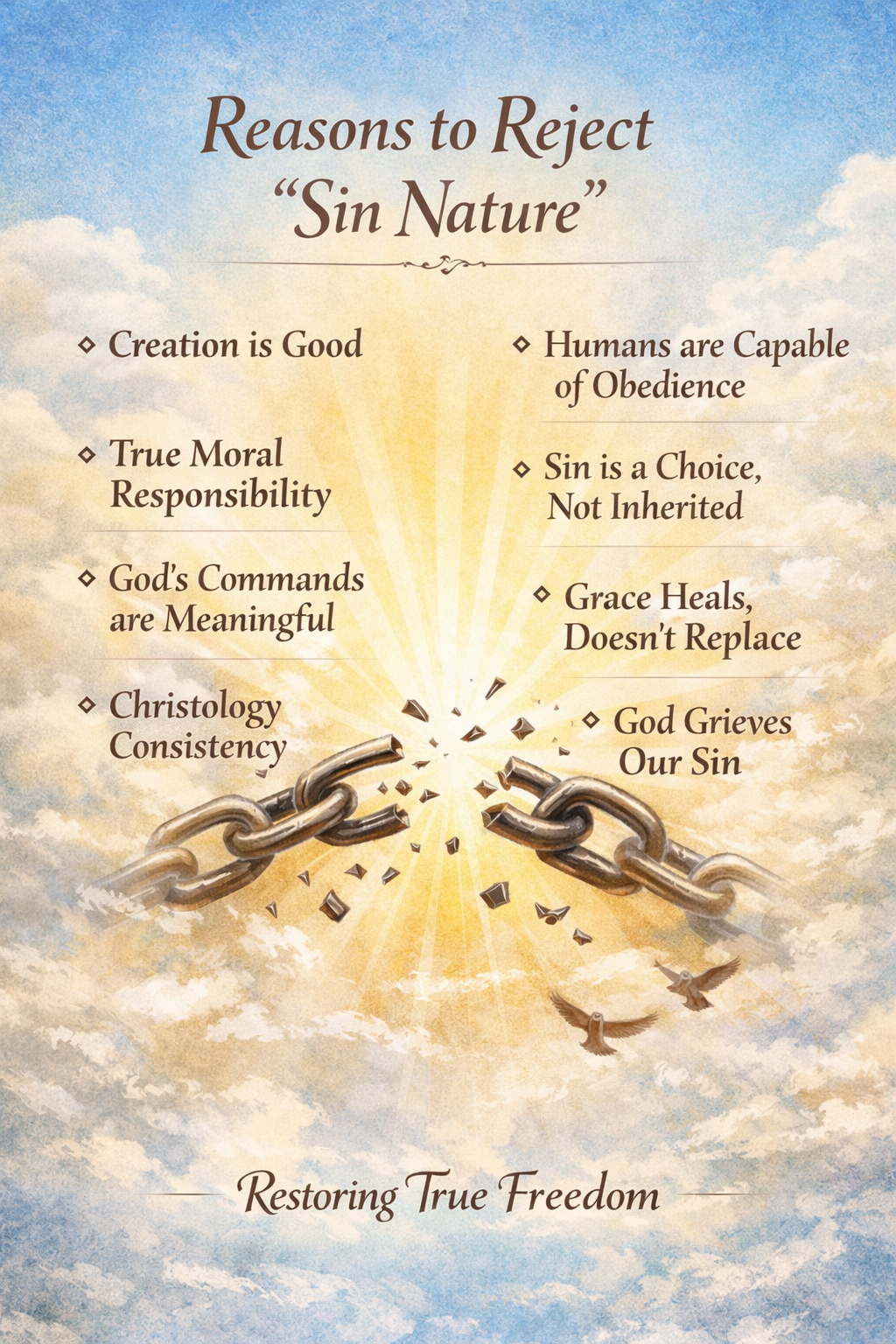
The problem is not that Scripture takes sin lightly. It does not. The problem is that Scripture never says the image of God was damaged. It never explicitly teaches humanity has sin at birth or even that humans are somehow damaged by the Fall and so they must sin. Instead, it simply and repeatedly insists that all do sin.
This distinction matters more than we often realize. What we believe about the image of God shapes how we understand judgment, grace, responsibility, repentance, sanctification, and even the humanity of Christ. If the image itself was broken, then moral responsibility becomes difficult to explain and Christ’s genuine temptation becomes hard to defend. If the image endures, however, then sin can be taken with full seriousness without collapsing into despair about human nature.
Scripture, I propose, teaches universal sin without teaching a broken image.
The Image of God as Calling, Not Condition
Genesis introduces the image of God not as a moral achievement or spiritual upgrade, but as a calling. Humanity is created “in the image of God” and immediately entrusted with responsibility, vocation, and relational address (Gen 1:26–28). The image is not defined by moral performance but by who humans are before they ever act rightly or wrongly.
This matters because Scripture continues to speak of the image of God after the Fall without qualification. After violence has spread across the earth, God grounds the prohibition of murder in the enduring reality that humans are made in His image (Gen 9:6). The psalmist celebrates humanity’s crowned dignity and delegated authority with no hint of ontological damage (Ps 8:4–6). James warns believers not to curse others precisely because they are made in God’s likeness (Jas 3:9).
These texts do not describe a damaged image barely hanging on. They assume the image remains intact as the basis for dignity, accountability, and moral restraint.
The simplest explanation is also the most faithful to the text: the image of God names humanity’s enduring capacity and vocation to live in holy relationship with God. Sin contradicts that vocation, but it does not erase the capacity itself.
Adam as Exemplar, Not Genetic Infection
Much confusion enters when Adam’s sin is treated as an ontological infection transmitting guilt or corruption to all his descendants. Scripture does not require this move.
Adam’s story reveals something about humanity rather than changing humanity’s nature. He shows us what free creatures do when trust in God is replaced by grasping autonomy. His failure is tragic, but it is exemplary, not biological. He is the first sinner, not the metaphysical cause of everyone else’s sin.
Paul’s argument in Romans 5 supports this reading. Adam and Christ are presented as representative figures whose actions inaugurate historical realities (Rom 5:12–19). Adam introduces sin and death into human history; Christ introduces obedience and life. Yet Paul never says guilt is inherited by all, nor that Christ’s gift is automatically applied to all. Both are participatory—both act as gateways through which people may choose to enter.
Augustine’s Greek was poor (he himself admits this in Confessions) and so he misunderstood the passage in Romans and thereby helped create the myth that sin infects everyone because of Adam rather than because people freely of their own will choose to sin. The Apostle Paul clearly states that death spreads because all sin: “Therefore, just as through one man sin entered into the world, and death through sin, and so death spread to all men, because all sinned” (Rom 5:12, NASB, see it in full context below).
If Adam’s guilt were transmitted automatically while Christ’s righteousness must be freely received, the parallel would collapse. But if Adam reveals what humanity does, and Christ reveals what humanity can be, the symmetry holds. Adam shows us humanity turned away from God; Christ shows us humanity faithfully aligned with God.
This in no way downplays the significance of Adam’s sin. By sinning, Adam introduces societal sin. People now from birth are impacted by sin and taught by example to sin. Sin naturally encourages counter-sin, possibly through the concepts of justice and vengeance. A desire for self-protection may explain at least some of the impulse for selfish action. Adam’s sin did result in the curses of pain in childbearing and toil in labor (Gen 3:16-17), but nowhere did God curse His own image in humanity.
Why Everyone Sins Without Being Born Broken
Scripture is unsparing in its assessment: all sin (Rom 3:23). The question is why.
The Bible consistently locates the universality of sin not in damaged creation, but in a disordered world. From Genesis onward, sin spreads socially, historically, and relationally. Violence, rivalry, and deception become normal patterns of life (Gen 4–6). The psalms lament a world where injustice is learned and practiced, not inherited as a defect (Ps 14:1–3).
The pathway of sin is clearly explained by James 1:13-15: “Let no one say when he is tempted, ‘I am being tempted by God’; for God cannot be tempted by evil, and He Himself does not tempt anyone. But each one is tempted when he is carried away and enticed by his own lust. Then when lust has conceived, it gives birth to sin; and when sin is accomplished, it brings forth death” (NASB).
Note that James is giving a detailed explanation of the process of sin, but he does not start with “sin nature” (a phrase not found in Scripture). He first insists sin does not come from God, then he explains it comes from each individual “carried away and enticed by his own lust.” The Greek word “his own” (idios) is distinct and clear—the sin is the individual’s own property. If there were a defect in the soul, some broken part that compels sin, James does not recognize it. In fact, he goes on to say “do not be deceived” and that humans are created by truth and among His first-fruits of creation (v18).
Paul traces human corruption to distorted worship and imitation. Humanity exchanges truth for falsehood, and God “hands them over” to the consequences of those choices (Rom 1:18–32). Sin becomes entrenched because it is reinforced, modeled, and normalized—not because the image of God has been damaged.
This explains how sin can be universal without being compulsory. Sin is inevitable in practice but not necessary in principle. Humans are born into a world where trust in God is costly, communion is diminished, and disobedience is learned early. Yet Scripture never treats sin as coerced. Judgment presupposes genuine agency.
Spiritual Inheritance Without a Broken Image
Scripture also affirms what might be called spiritual inheritance—the real transmission of patterns, environments, and pressures shaped by the sins or faithfulness of prior generations. This is not an inheritance from Adam but from direct forefathers. God warns that the consequences of sin may echo “to the third and fourth generation” (Exod 20:5–6), not because guilt is inherited, but because sin forms habits, normalizes desires, and reshapes moral landscapes.
These inherited pressures do not compel sin, yet they can make particular forms of temptation more acute. A child raised amid violence, addiction, or injustice may face stronger invitations toward those same patterns—not because their nature is damaged, but because sin is learned, reinforced, and modeled.
At the same time, Scripture is equally clear that spiritual inheritance is not determinative. A son may refuse the path of his father and truly live (Ezek 18:14–17). God’s mercy decisively outweighs sin, promising blessing “to the thousandth generation” of those who love Him (Exod 20:6). There is no inevitable accumulation of corruption. One faithful generation can interrupt many faithless ones, because grace flows from God’s abundance rather than human effort. This does not describe a flaw in the image of God, but a characteristic of sin itself—that it spreads relationally and is judged justly because it is chosen anew by each person.
To sin is to refuse to reflect God. Sin is not merely a mistake but a relational rupture—a turning of the soul away from the Light. Because holiness is not partial, a single sin is enough to fracture perfect reflection and to separate humanity from God, whose life is the source of all life. Scripture is therefore unambiguous: “you will surely die.” A just and truthful God cannot revoke His own word without undoing justice itself. Humanity’s exile into death is not arbitrary punishment but the natural consequence of refusing the Source of life, a sentence that awaited fulfillment until Christ bore death on our behalf.
This clarification is essential: a person’s first sin is not compelled by nature, defect, or inherited propensity. It is freely chosen. Only after an individual sins does what Scripture calls “the flesh” emerge—not as a flaw in the image of God, but as the entrenched pattern of disordered desire, habituated resistance, and weakened trust that sin produces over time. The image is not destroyed, but its reflection is obscured like a twisted mirror. From that point forward, divine grace must precede and awaken our response. Prevenient grace is therefore not a repair of broken ontology, but God’s merciful initiative toward enslaved wills—calling, illuminating, and enabling repentance and faith without coercion.
Christ and the Integrity of Temptation
Everything comes into focus when Christ enters the picture.
Hebrews insists Jesus was “tempted in all things as we are, yet without sin” (Heb 4:15). That statement cannot be taken lightly. Temptation only matters if obedience is genuinely possible. If humanity is born morally incapacitated, then Christ must either be exempt from true humanity or exempt from true temptation. Neither option works.
Christ does not succeed because He possesses a different kind of humanity. He succeeds because He lives faithful humanity within the same conditions of finitude, vulnerability, and pressure that mark human life after Adam. His obedience is not effortless; it is trusting. His victory is not metaphysical; it is relational. Christ didn’t only come to die for us; He came to live for us—showing us, in flesh and blood, the perfect life we’re meant to imitate. He didn’t merely come to pay the penalty for our failures; He came to display the perfection we’re invited to pursue.
This is precisely why Christ can reveal humanity rather than replace it. He shows us not what humans would do if repaired, but what humans can do when fully aligned with God. Redemption, therefore, is not the repair of a broken image but the restoration of humanity to its original calling through participation in Christ’s faithful life (Rom 8:29; 2 Cor 3:18).
What About the “Proof Texts”?
Several passages are often cited as evidence of inherited corruption, but none require that conclusion. Psalm 51:5 is a poetic confession emphasizing the depth of David’s guilt, not a metaphysical claim about conception. He is clearly using hyperbole in the midst of his despair, as he says he only sinned against God (verse 4) but he also sinned against others, and he says God broke his bones (verse 8) which must be what his anguish felt like but that did not happen literally.
As we have mentioned, Romans 5 emphasizes historical consequence and representative action, not biological transmission. The concluding point is easy to misunderstand as it states: “For as through the one man's disobedience the many were made sinners, even so through the obedience of the One the many will be made righteous” (Romans 5:19). Note the “For as…even so” construction—in the same way that Adam brought sin Jesus brings righteousness. Adam was the gateway of sin, Christ the gateway to freedom from sin. Neither gateway is coercive—we choose where we walk. Note also that it is not “all” who sin or are saved but “the many.” Jesus Christ was made just like us, but without sin—He was the great exception to Adam’s example. Now we can be made like Him, but we must participate in Him to be made righteous. If not all are automatically righteous because of Christ, then not all are automatically sinful because of Adam.
Ephesians 2:3 describes a way of life shaped by habituated disobedience, not a corrupted created essence. Romans 7 uses the term “the flesh” but it simply means one’s own sin, not some inherited defect. Paul is describing a person who relies upon their own righteousness rather than faith for salvation. This is Paul describing the defeated person (not himself) who relies upon works instead of faith for righteousness. Greek uses first person (“I”) to explain exemplars whereas in English we would say “one does that which one did not wish to do.” [See the article Defeated Christian Life in sidebar for more details]
This is made abundantly clear simply by reading further. Paul doesn’t conclude we are flawed by nature or that our human nature changes at salvation but rather he says we are freed--set free from our sin (our inability to follow the law) by faith in Jesus Christ and the infusion of God’s love. Not being “under the law” does not mean the law is abolished but rather that we are now “above” it in the sense that we not only do right by God and others but we want to do right out of a heart of love. Love sums up the law and the prophets.
Many other passages have been erroneously cited to back a sinful condition before an individual sins, but they pretty much all are speaking about the individual’s sin and its consequences. They do not presuppose a defected image or inherited guilt at birth. Indeed, Ezekiel explicitly denies inherited guilt (Ezek 18:20), and John frames judgment around response to light, not inherited condition (John 3:19–21). Scripture is consistent: sin is universal, serious, and accountable—but it is enacted, not inherited as an ontological defect.
Why This Matters
If the image of God was damaged, responsibility becomes fragile and grace becomes compensatory. But if the image endures, then judgment makes sense and grace becomes restorative rather than corrective. This in no way erases the idea that God is the initiator of grace—it is gracious that God even creates us, and Jesus said His grace and invitation would radiate to all from the cross when He declared: "And I, if I be lifted up from the earth, will draw all men to Myself" (Jn. 12:32 NAS).
God does not make people with defects, and it would not be fair to judge the child for the father’s sin. Every human chooses anew to forsake the loving Creator, to go astray, each their own way, in sin. Every person is guilty before a holy God. God may justly condemn us because we are responsible for our own sin. On the Day of Judgement, we will be revealed as the summation of our choices, and we will be without excuse.
But that is not the end of the story. God decided He would rather die than live without us. He became incarnated in Jesus and paid the full penalty of death for every sin that ever was or ever will be (1 Jn 2:2; 2 Cor 5:14-15). He may offer true salvation to all because He paid restitution for all.
When we repent we are forgiven, and then we begin to grow in sanctification as we image the Holy God. All people are made in God’s image, all have the capacity for holiness, but only the sons and daughters of God who follow Christ begin to activate that image and gloriously begin to resemble their Father in Heaven.
This recovery of truth allows Christ to be seen not only as the one who dies for humanity, but as the one who lived for us and revealed what humanity was intended to be. God did not fix broken humanity; He restored true humanity in Christ. He calls us not to a life of perpetual sin and forgiveness because we are inherently flawed, but to become a new creation in Christ (2 Cor 5:17). Our new self is not foreign nor imposed but involves surrendering to God so that we might become what we were always created to be. We are no longer slaves to sin, we are slaves to righteousness because we love (Rom. 6:19). God was never interested in making broken creatures and then repairing them by force. Instead, God lovingly seeks willing children who freely return home.
NOTE: For your convenience, full cited scripture are included at the end of the article.
A Clarifying Historical Note: Pelagius, Augustine, and Power
Much of Western theology has inherited a sharply caricatured portrait of Pelagius, often filtered almost entirely through Augustine’s polemics and later Calvinist reception. That portrait has frequently been used as a boundary marker: anything that resists inherited guilt, deterministic anthropology, or irresistible grace is quickly labeled “Pelagian,” regardless of whether Pelagius himself held the positions attributed to him. Many historians now agree that Pelagius likely did not affirm several of the claims later ascribed to him, and that the controversy became as much about competing theological trajectories as about his actual teaching.
The early Church itself drew careful distinctions. The Council of Carthage rightly rejected the idea that humans could stand before God as righteous apart from grace, because such a view would reduce Christ to a mere moral exemplar rather than the indispensable Redeemer. We fully affirm that judgment. Humanity does not save itself, initiate its own redemption, or render the cross optional. Salvation requires an atoning Savior. Grace is not a supplement to human effort; it is the very ground of reconciliation and new life.
It is also worth noting that later theological developments—especially during the Reformation—were shaped not only by doctrinal concerns but by questions of authority and power. After prolonged religious wars in Europe, the Treaty of Westphalia resolved conflict not by theological consensus but by assigning doctrinal control to territorial rulers. Conscience was subordinated to jurisdiction. The American experiment arose, in part, as a rejection of that arrangement, affirming freedom of religion rather than enforced confessional uniformity.
LUMEN stands within this freedom of conscience. It does not deny sin, judgment, grace, or the necessity of Christ. It simply refuses to confuse historical polemics with biblical anthropology, or coercive systems with the gospel itself. Christ is not diminished by rejecting inherited guilt or deterministic models; He is magnified as the One who truly saves, truly liberates, and truly restores humanity to what it was created to be.
Scripture from Above (NASB)
Genesis 1:26–28 Then God said, “Let Us make mankind in Our image, according to Our likeness; and let them rule over the fish of the sea and over the birds of the sky and over the livestock and over all the earth, and over every crawling thing that crawls on the earth.” So God created man in His own image, in the image of God He created him; male and female He created them. God blessed them; and God said to them, “Be fruitful and multiply, and fill the earth, and subdue it; and rule over the fish of the sea and over the birds of the sky and over every living thing that moves on the earth.”
Genesis 9:6 Whoever sheds human blood, By human his blood shall be shed, For in the image of God He made mankind.
Psalm 8:4–6 What is man that You think of him, And a son of man that You are concerned about him? Yet You have made him a little lower than God, And You crown him with glory and majesty! You have him rule over the works of Your hands; You have put everything under his feet.
James 3:9 With it we bless our Lord and Father, and with it we curse people, who have been made in the likeness of God.
Romans 5:12–19 Therefore, just as through one man sin entered into the world, and death through sin, and so death spread to all men, because all sinned--for until the Law sin was in the world; but sin is not imputed when there is no law. Nevertheless death reigned from Adam until Moses, even over those who had not sinned in the likeness of the offense of Adam, who is a type of Him who was to come.
But the free gift is not like the transgression. For if by the transgression of the one the many died, much more did the grace of God and the gift by the grace of the one Man, Jesus Christ, abound to the many. And the gift is not like that which came through the one who sinned; for on the one hand the judgment arose from one transgression resulting in condemnation, but on the other hand the free gift arose from many transgressions resulting in justification.
For if by the transgression of the one, death reigned through the one, much more those who receive the abundance of grace and of the gift of righteousness will reign in life through the One, Jesus Christ. So then as through one transgression there resulted condemnation to all men, even so through one act of righteousness there resulted justification of life to all men. For as through the one man's disobedience the many were made sinners, even so through the obedience of the One the many will be made righteous.
Romans 3:23 for all have sinned and fall short of the glory of God.
Psalm 14:1–3 The fool has said in his heart, “There is no God.” They are corrupt, they have committed detestable acts; There is no one who does good. The Lord has looked down from heaven upon the sons of men To see if there are any who understand, Who seek God. They have all turned aside, together they are corrupt; There is no one who does good, not even one.
James 1:13-18 Let no one say when he is tempted, "I am being tempted by God"; for God cannot be tempted by evil, and He Himself does not tempt anyone. But each one is tempted when he is carried away and enticed by his own lust. Then when lust has conceived, it gives birth to sin; and when sin is accomplished, it brings forth death. Do not be deceived, my beloved brethren. Every good thing bestowed and every perfect gift is from above, coming down from the Father of lights, with whom there is no variation, or shifting shadow. In the exercise of His will He brought us forth by the word of truth, so that we might be, as it were, the first fruits among His creatures.
Romans 1:18–32 (summary of key theme; full passage describes God's wrath against suppressed truth, leading to being "handed over" to consequences) For the wrath of God is revealed from heaven against all ungodliness and unrighteousness of people who suppress the truth in unrighteousness... Therefore God gave them up to vile affections... And just as they did not see fit to acknowledge God, God gave them up to a depraved mind, to do those things that are not proper...
Exodus 20:5–6 You shall not worship them nor serve them; for I, the Lord your God, am a jealous God, visiting the guilt of the fathers on the children, on the third and fourth generations of those who hate Me, but showing favor to thousands, to those who love Me and keep My commandments.
Ezekiel 18:14–17 Now behold, he has a son who has observed all his father’s sins which he committed, and observing does not do likewise. He does not eat at the mountain shrines or raise his eyes to the idols of the house of Israel, or defile his neighbor’s wife, or oppress anyone, or retain a pledge, or commit robbery, but gives his bread to the hungry and covers the naked with clothing. He keeps his hand from the poor, does not take interest or increase, but executes My judgments and walks in My statutes; he will not die for his father’s wrongdoing, he will surely live.
Hebrews 4:15 For we do not have a high priest who cannot sympathize with our weaknesses, but One who has been tempted in all things just as we are, yet without sin.
Romans 8:29 For those whom He foreknew, He also predestined to become conformed to the image of His Son, so that He would be the firstborn among many brothers and sisters.
2 Corinthians 3:18 But we all, with unveiled faces, looking as in a mirror at the glory of the Lord, are being transformed into the same image from glory to glory, just as from the Lord, the Spirit.
Psalm 51:5 Behold, I was brought forth in guilt, And in sin my mother conceived me.
Ephesians 2:3 Among them we too all previously lived in the lusts of our flesh, indulging the desires of the flesh and of the mind, and were by nature children of wrath, just as the rest.
Ezekiel 18:20 The person who sins will die. A son will not bear the punishment for the father’s guilt, nor will a father bear the punishment for the son’s guilt; the righteousness of the righteous will be upon himself, and the wickedness of the wicked will be upon himself.
John 3:19–21 And this is the judgment, that the Light has come into the world, and people loved the darkness rather than the Light; for their deeds were evil. For everyone who does evil hates the Light, and does not come to the Light, so that his deeds will not be exposed. But the one who practices the truth comes to the Light, so that his deeds will be revealed as having been performed in God.
John 12:32 And I, if I be lifted up from the earth, will draw all men to Myself.
1 John 2:2 He Himself is the propitiation for our sins; and not for ours only, but also for those of the whole world.
2 Corinthians 5:14–15 For the love of Christ controls us, having concluded this, that one died for all, therefore all died; and He died for all, so that they who live might no longer live for themselves, but for Him who died and rose again on their behalf.
2 Corinthians 5:17 Therefore if any man is in Christ, he is a new creature; the old things passed away; behold, new things have come.
Romans 6:19 I am speaking in human terms because of the weakness of your flesh. For just as you presented your members as slaves to impurity and to lawlessness, resulting in further lawlessness, so now present your members as slaves to righteousness, resulting in sanctification.