The Defeated Christian Life
by Dr. Peter A. Kerr
Today’s Church is plagued by what might rightly be called the “gospel of defeat”—a Christianity that preaches forgiveness without transformation, that celebrates grace while quietly surrendering holiness. This teaching assures people that sin is unavoidable, expected, and even normal, so long as it is repeatedly forgiven. Many pastors live defeated Christian lives and speak of it openly from the pulpit. They testify, often unintentionally, to Christ’s supposed inability to change their sinful natures, explaining that sin remains alive and well within them.
Often they declare they are “sinners saved by grace” rather than seeing in Scripture they are called “saints saved from sin.” They believe their testifying to personal enslavement to sin shows humility, even while it quietly contradicts the promise of the gospel and soothes the conscience of people choosing sin in the congregation. To normalize sin is not grace; it is to misunderstand the purpose of grace altogether.
I once had a pastor who confessed during a sermon that he sinned multiple times every day, yet expressed gratitude that God forgave him and that it was Jesus’ blood on which he relied. After the service I confronted him. I asked why I should entrust myself to his pastoral care if sin ruled his daily life. I asked how he could lead others into an overcoming life in Christ if he himself experienced no real freedom. He responded weakly that these were “small sins…like everybody has.”
He had absorbed the assumption that sin was inevitable and justified himself with the logic that “everyone does it.” I then asked whether he felt bound to sin—whether he experienced himself as a slave to it. Thinking I was expressing sympathy, he readily agreed. That was exactly how he felt. I then quoted Romans 6:17–18: “But thanks be to God that though you were slaves of sin, you became obedient from the heart to that form of teaching to which you were committed, and having been freed from sin, you became slaves of righteousness” (Rom. 6:17–18).
For Christians, just as we were once enslaved to sin, we are now given over to righteousness. Before coming to Christ, our nature was oriented toward sin in such a way that we could not escape it. After coming to Christ, our nature is reoriented toward holiness in such a way that we can no longer remain at home in sin. “No one who has been born of God practices sin, because His seed remains in him; and he cannot persist in sin, because he has been born of God” (1 John 3:9).
When we are saved, we are welcomed into God’s family, and one defining family trait is holiness. This does not mean instant perfection, but it does mean a decisive change of direction. We do not have to sin (1 Cor 10:13), and we cannot continually choose it without resistance from the new life within us. Imagine pulling someone out of the mud and washing them clean, only to watch them jump right back in. They make no effort to remain clean, even though they have been shown a better way. Over time, even patience grows weary—not because love has failed, but because love will not force what must be freely received. God’s patience is extraordinary, yet wisdom invites us to respond to grace rather than presume upon it.
The “flesh” nature created by past choices has been decisively defeated, is presently being put to death, and will one day be fully removed. At salvation, our old self—our former sin-dominated identity—was crucified with Christ (Rom. 6:6; Gal. 2:20; Col. 3:3). The flesh may still exert pressure, which is why Scripture calls us to live by the Spirit. Romans 8:13 explains, “For if you are living in accord with the flesh, you are going to die; but if by the Spirit you are putting to death the deeds of the body, you will live.” This is not the struggle of defeat, but the struggle of healing. We are resisting the final convulsions of a power that no longer reigns (Col. 3:5), even as “our outer person is decaying, yet our inner person is being renewed day by day” (2 Cor. 4:16).
This process will culminate in complete freedom as the Spirit restores our nature to fully reflect God’s own life. Sin’s authority was broken at the cross, sin’s residue is being dismantled through sanctification, and sin’s presence will be abolished entirely in glorification.
Those who have made peace with the “gospel of defeat” often appeal to Romans 7 as their proof. Yet this passage is not Paul confessing a defeated Christian life. The confusion arises largely from reading Romans 7 in isolation rather than within its larger argument, though it is also compounded by Greek rhetorical convention. In Greek, an author commonly used the first person (“I”) where we might use a general example (“one”). Where we would say, “one does what one does not want to do,” Paul says, “I do what I do not want to do.”
That Paul is exposing the futility of life under sin rather than describing his present Christian experience becomes clear when the surrounding chapters are read together. In Romans 6 he declares, “We know that our old self was crucified with Him, so that the body of sin might be done away with, so that we would no longer be slaves to sin… For sin shall not be master over you” (Rom. 6:6, 14). Romans 7 ends not in despair but in deliverance. Paul cries out:
“Wretched man that I am! Who will set me free from the body of this death? Thanks be to God through Jesus Christ our Lord! … There is therefore now no condemnation for those who are in Christ Jesus. For the law of the Spirit of life in Christ Jesus has set you free from the law of sin and of death” (Rom. 7:24–8:2).
The “body of death” refers to the flesh, the old sin-oriented nature. Virgil, in the Aeneid, describes a Roman punishment in which a corpse was bound to a murderer, allowing decay to destroy the living body. Paul draws on this image to proclaim liberation: our flesh once compelled us toward sin, but Christ has severed that bond. We may still bear wounds from its decay, but we are no longer dying from sin—we are being healed from it.
The gospel of defeat surfaces in many other features of modern church life. Worship songs frequently confess sin while repeatedly reassuring us that God “will not fail us,” subtly positioning humanity as the fragile center of the story. Gone are hymns that summoned believers toward courage and faithfulness, replaced by declarations that focus almost exclusively on God’s reliability in the face of our ongoing failure.
It can begin to appear as though God exists primarily to forgive us while we remain unchanged, rather than that we exist to love God and grow into His likeness. Even corporate prayer can drift into ritualized self-contempt, with believers repeatedly declaring themselves incapable, unworthy, and perpetually sinful. Such patterns unintentionally train the Church to expect defeat. A church without holiness does not bear witness to transforming love, nor can it reflect the life of Christ to the world. Without holiness, the body forgets how to live.
There is a better way. The gospel does not announce that we are forgiven but forever fractured; it proclaims that we are forgiven in order to be made whole. Holiness is not the suppression of desire but the reorientation of it, not the erasure of humanity but its illumination. In Christ, God does not merely pardon sinners—He adopts children, heals vision, and restores love to its proper object.
The Spirit patiently trains our attention, reshapes our habits, and aligns our lives with the light we have received. As we behold Christ, we learn to reflect Him, not by strain but by participation. This is not triumphalism, nor is it defeat. It is faithful confidence that holy love is stronger than sin, that grace truly transforms, and that the life of God is even now being formed within us.
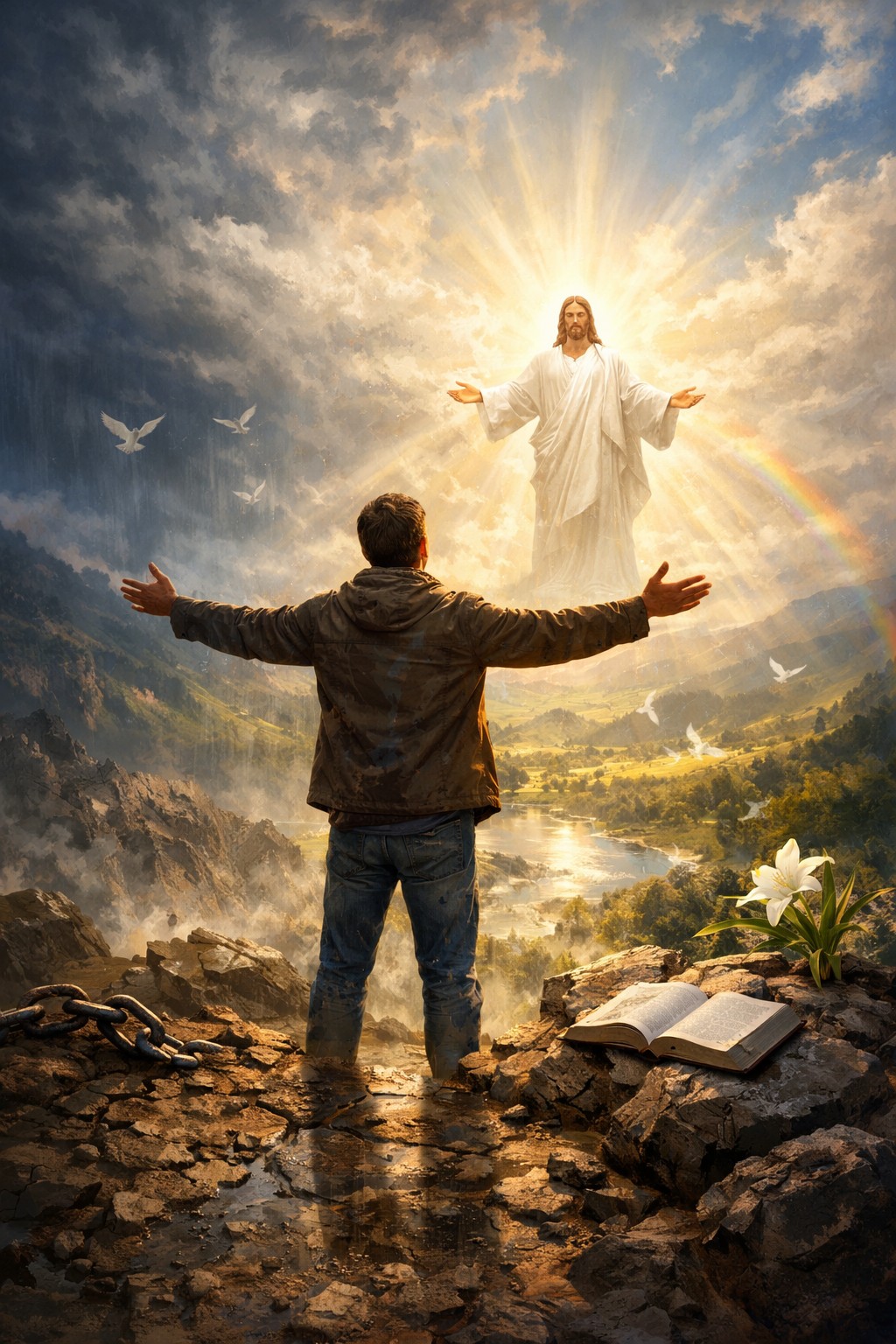
A Prayer for Renewal
Father,
I come to You in trust, grateful for Your goodness and Your love. I confess where I have grown comfortable with sin and where I have expected defeat instead of transformation.
Forgive me for what I have done and for believing I could not be changed.
Thank You for the life You have given me in Christ and for freeing me from sin’s rule. I receive again Your gift of forgiveness, and I open my life to the work You are doing within me.
Please fill me with Your Spirit. Renew my desires, reshape my habits, and train my attention toward what is holy and good.
Help me live as a child of Your family and reflect Your holiness in love.
Today I turn from a life of defeat and choose a life of growing alignment with Your will. Form Christ’s life within me, so that my life may bear good fruit for Your glory and the good of others.
It is in Jesus’ name I pray, Amen.
Romans 6:17–18 But thanks be to God that though you were slaves of sin, you became obedient from the heart to that form of teaching to which you were committed, and having been freed from sin, you became slaves of righteousness.
1 John 3:9 No one who is born of God practices sin, because His seed abides in him; and he cannot sin, because he is born of God.
1 Corinthians 10:13 No temptation has overtaken you but such as is common to man; and God is faithful, who will not allow you to be tempted beyond what you are able, but with the temptation will provide the way of escape also, so that you will be able to endure it.
Romans 6:6 knowing this, that our old self was crucified with Him, in order that our body of sin might be done away with, so that we would no longer be slaves to sin;
Galatians 2:20 I have been crucified with Christ; and it is no longer I who live, but Christ lives in me; and the life which I now live in the flesh I live by faith in the Son of God, who loved me and gave Himself up for me.
Colossians 3:3 For you have died and your life is hidden with Christ in God.
Romans 8:13 for if you are living according to the flesh, you must die; but if by the Spirit you are putting to death the deeds of the body, you will live.
Colossians 3:5 Therefore consider the members of your earthly body as dead to immorality, impurity, passion, evil desire, and greed, which amounts to idolatry.
2 Corinthians 4:16 Therefore we do not lose heart, but though our outer man is decaying, yet our inner man is being renewed day by day.
Romans 6:6, 14 knowing this, that our old self was crucified with Him, in order that our body of sin might be done away with, so that we would no longer be slaves to sin; ... For sin shall not be master over you, for you are not under law but under grace.
Romans 7:24–8:2 Wretched man that I am! Who will set me free from the body of this death? Thanks be to God through Jesus Christ our Lord! So then, on the one hand I myself with my mind am serving the law of God, but on the other, with my flesh the law of sin. Therefore there is now no condemnation for those who are in Christ Jesus. For the law of the Spirit of life in Christ Jesus has set you free from the law of sin and of death.