LUMEN and Wesleyanism: The Vision Comes Fully into Focus
by Dr. Peter A. Kerr
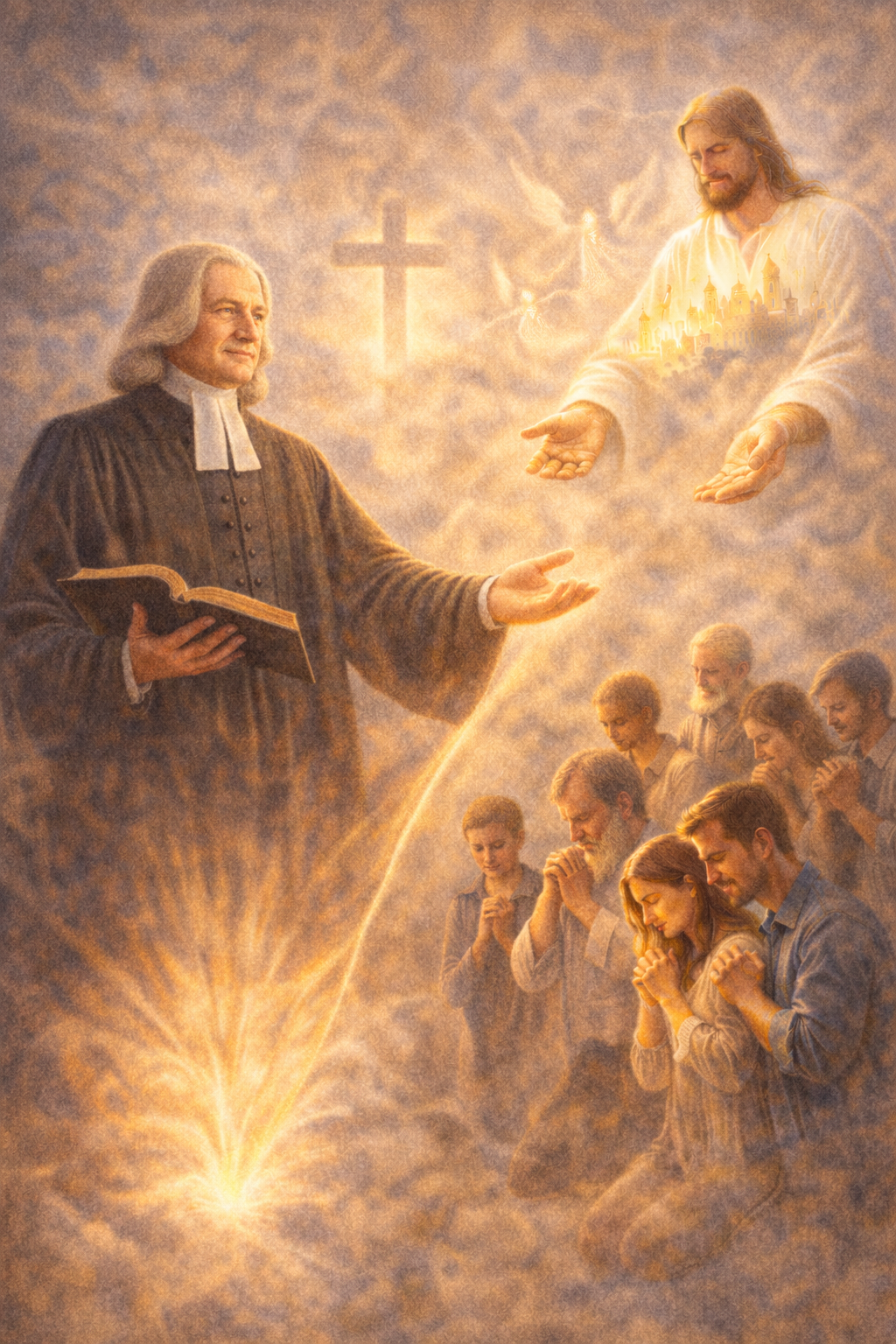
Wesleyan theology has long stood as one of Christianity’s most hopeful, humane and evangelical traditions. It resists fatalism. It affirms genuine human freedom. It insists holiness is not optional and that love, not mere acquittal, is God’s aim. Wesleyanism already gestures toward what LUMEN seeks to articulate more fully.
Rather than rejecting the Wesleyan vision, LUMEN receives it, clarifies it, and grounds it more deeply in Scripture by asking a prior question Wesley himself often implied but did not systematize: What must God be like for holiness, freedom, and love to be genuinely good news?
Holiness: From Ethical Path to Divine Reality
Wesleyan theology rightly emphasizes holiness as the shape of the Christian life. Holiness describes the life of love God calls believers to walk—a life empowered by grace and oriented toward perfect love of God and neighbor (Matthew 22:37–40). Wesley’s great contribution was refusing to reduce salvation to forgiveness alone.
LUMEN affirms this emphasis but presses it deeper by rooting holiness first in God rather than in the moral life. Scripture consistently presents holiness not merely as God’s expectation but as God’s very being. “Holy, holy, holy is the Lord of hosts” (Isaiah 6:3). God does not follow a holy path; He is holy.
This matters because Scripture repeatedly grounds human holiness in participation rather than imitation alone. “Be holy, for I am holy” (Leviticus 19:2; 1 Peter 1:15–16) is not merely an ethical summons but an invitation into shared life. Holiness flows from communion, not compliance.
LUMEN fulfills the Wesleyan impulse by clarifying that holiness is not primarily a moral achievement but a relational reality. Ethics remain essential, but they arise from beholding who God is rather than striving toward an abstract standard.
Sin: From Inherited Bent to Misdirected Love and Relinquished Domain
Wesleyan theology famously rejects strict Augustinian determinism and affirms prevenient grace. Yet it often retains a moderated account of a sinful nature—an inherited inclination toward sin that explains the universality of moral failure.
LUMEN proposes Scripture does not require this move. The Bible insists that all sin (Romans 3:23), but it does not teach humans are born morally damaged or ontologically bent toward evil. Instead, Scripture consistently locates sin in choice, desire, and allegiance. “Each one is tempted when he is carried away and enticed by his own desire” (James 1:14). Sin is also ubiquitous due to the environment, as Adam relinquished domain of the earth (see the Domain article).
Sin, in LUMEN, is not an inherited defect but misdirected love. Humanity was created good (Genesis 1:31), capable of loving God, yet free to turn inward. The fall does not destroy the image of God; it distorts its direction. Scripture never says the image was lost or corrupted (Genesis 9:6; James 3:9).
This fulfills the Wesleyan concern for responsibility and transformation. If sin were rooted in nature, responsibility would be compromised and holiness would always fight an internal defect. Scripture instead presents sin as relational rupture and chosen self-exaltation, preserving both accountability and hope. While a propensity for sin may be inherited to the third and fourth generations, it is a learned or normalized behavior and it does not extend back to Adam. Every person is fully guilty for their own first sin, and the ensuing flesh nature.
Freedom and Divine Action: From Non-Coercion to Pedagogy
Wesleyan theology rightly insists God does not coerce the human will with regard to salvation. Grace enables, invites, and empowers, but does not override freedom. This stands firmly on biblical ground. “Choose this day whom you will serve” (Joshua 24:15). “I have set before you life and death… so choose life” (Deuteronomy 30:19).
LUMEN affirms this fully but deepens the application and the reason. God does not merely refrain from coercion out of fairness, but also because coercion contradicts holy love and constitutes the destruction of the person God created in His image. Love that forces is no longer love (1 Corinthians 13:4–7). Only free choices can be judged, and at the eschaton all people will be known as the summation of their free choices.
God not only refuses to force people into salvation, He refuses to force anyone’s will. Instead He invites, encourages, arranges circumstances, hardens, and even works poor choices to good for those who love Him. This is not due to lack of power but lack of desire. To force human will would be to destroy the very image of God He placed within humanity which is the capacity to be holy.
Scripture portrays God’s action as patient, formative, and invitational. God reasons, warns, waits, teaches, and persuades. Jesus weeps over Jerusalem rather than overriding it (Luke 19:41–44). God desires all to be saved, yet does not force salvation (1 Timothy 2:4).
LUMEN frames the human experience as pedagogy rather than mere permission. God is not reluctantly allowing freedom; He is intentionally forming a family capable of shared life and shared reign (Romans 8:17; Revelation 22:5). History is the classroom of holy love.
Sanctification: From Moral Victory to Participatory Transformation
Wesley’s hope for entire sanctification rightly affirmed believers need not remain enslaved to sin. Scripture indeed calls believers to expect transformation (Romans 6:6–7). LUMEN receives this hope while reframing its center.
Sanctification is not primarily the eradication of impulses but the reordering of love and worship. “We all, with unveiled face, beholding the glory of the Lord, are being transformed” (2 Corinthians 3:18). Transformation flows from beholding God and switching worship from self to Him, rather than from human striving. This protects the Wesleyan vision from moral anxiety and quiet perfectionism. Growth remains real, but its measure is increasing alignment with God’s self-giving love rather than arrival at a moral state.
Prayer: From Earnest Striving to Trustful Participation
Wesleyan spirituality often emphasizes vigilance, discipline, and earnest prayer. LUMEN affirms these practices but clarifies their purpose. Prayer is not leverage to achieve holiness; it is participation in God’s life. “Your will be done” (Matthew 6:10) is the heart of Christian prayer. Scripture presents prayer as trustful dependence, not anxious effort (Philippians 4:6–7). LUMEN preserves the Wesleyan call to holiness by freeing prayer from control and grounding it in communion.
Wesleyan theology asked the right questions: Can love be real? Can holiness be joyful? Can freedom matter? LUMEN agrees with Wesley that Scripture answers yes to all three—if holiness is first understood as who God is rather than merely what God commands. In this way, LUMEN does not abandon the Wesleyan vision. It fulfills it by anchoring holiness, freedom, and sanctification in the radiant fullness of God’s holy love.

Catholic, and Eastern Christian Overlap
LUMEN stands close to both Catholic and Eastern Christian theology at some of the most important points, while also clarifying key differences. Seeing these side by side helps show why LUMEN functions as a grammar rather than a new tradition.
Greatest areas of overlap
• Holiness as participation, not mere pardon
Like Catholic and Eastern theology, LUMEN rejects the idea that salvation is only legal forgiveness. Holiness involves real transformation through participation in God’s life, not merely a change of status.
• Love as the end of salvation
All three see love—not fear, control, or reward—as God’s ultimate aim. Growth in love, not avoidance of punishment, defines maturity.
• God as non-coercive
Especially resonant with Eastern thought, LUMEN affirms that God draws, invites, and illumines rather than overrides the will. True communion requires freedom.
• Healing rather than punishment
Sin is understood less as crime and more as sickness or distortion. God’s work is restorative and therapeutic, not primarily retributive.
Greatest points of contrast
• Holiness as God’s being, not a moral ladder
Catholic theology often frames holiness within moral law and virtue formation, and Eastern theology within ascetical ascent. LUMEN affirms moral formation but insists holiness first names who God is—fullness of self-giving love—before it names what humans do.
• No inherited sin nature
LUMEN explicitly rejects any doctrine of inherited moral defect. Unlike Catholic original sin formulations or Eastern ancestral sin language, LUMEN holds that all sin arises from freely misdirected love, not damaged human nature.
• Pedagogy over ontology of fallenness
Eastern theology often emphasizes humanity’s wounded condition, and Catholic theology emphasizes loss of original righteousness. LUMEN reframes history as pedagogical rather than primarily reparative: God is forming a family capable of shared life and shared reign, not restoring a broken mechanism.
• Grammar rather than sacramental or ascetical system
Catholicism centers sacramental mediation; Eastern theology centers ascetical participation. LUMEN does not replace these practices but explains why they work: they train reception, trust, and love rather than earning grace or climbing toward God.
In short
Catholic and Eastern traditions preserve profound truths about participation, healing, and holiness. LUMEN seeks to clarify their shared intuition by grounding holiness directly in God’s being, rejecting inherited moral defect, and framing salvation as formative participation in holy love.
LUMEN does not compete with these traditions.
It offers a lens through which their deepest insights cohere.
All Scripture in NASB
Matthew 22:37–40 “And He said to him, ‘“YOU SHALL LOVE THE LORD YOUR GOD WITH ALL YOUR HEART, AND WITH ALL YOUR SOUL, AND WITH ALL YOUR MIND.” This is the great and foremost commandment. The second is like it, “YOU SHALL LOVE YOUR NEIGHBOR AS YOURSELF.” On these two commandments depend the whole Law and the Prophets.’”
Isaiah 6:3 “And one called out to another and said, ‘Holy, Holy, Holy, is the LORD of hosts, The whole earth is full of His glory.’”
Leviticus 19:2 “Speak to all the congregation of the sons of Israel and say to them, ‘You shall be holy, for I the LORD your God am holy.’”
1 Peter 1:15–16 “but like the Holy One who called you, be holy yourselves also in all your behavior; because it is written, ‘YOU SHALL BE HOLY, FOR I AM HOLY.’”
Romans 3:23 “for all have sinned and fall short of the glory of God,”
James 1:14 “But each one is tempted when he is carried away and enticed by his own lust.”
Genesis 1:31 “God saw all that He had made, and behold, it was very good. And there was evening and there was morning, the sixth day.”
Genesis 9:6 “Whoever sheds man’s blood, By man his blood shall be shed, For in the image of God He made man.”
James 3:9 “With it we bless our Lord and Father, and with it we curse men, who have been made in the likeness of God;”
Joshua 24:15 “If it is disagreeable in your sight to serve the LORD, choose for yourselves today whom you will serve: whether the gods which your fathers served which were beyond the River, or the gods of the Amorites in whose land you are living; but as for me and my house, we will serve the LORD.”
Deuteronomy 30:19 “I call heaven and earth to witness against you today, that I have set before you life and death, the blessing and the curse. So choose life in order that you may live, you and your descendants,”
1 Corinthians 13:4–7 “Love is patient, love is kind and is not jealous; love does not brag and is not arrogant, does not act unbecomingly; it does not seek its own, is not provoked, does not take into account a wrong suffered, does not rejoice in unrighteousness, but rejoices with the truth; bears all things, believes all things, hopes all things, endures all things.”
Luke 19:41–44 “When He approached Jerusalem, He saw the city and wept over it, saying, ‘If you had known in this day, even you, the things which make for peace! But now they have been hidden from your eyes. For the days will come upon you when your enemies will throw up a barricade against you, and surround you and hem you in on every side, and they will level you to the ground and your children within you, and they will not leave in you one stone upon another, because you did not recognize the time of your visitation.’”
1 Timothy 2:4 “who desires all men to be saved and to come to the knowledge of the truth.”
Romans 8:17 “and if children, heirs also, heirs of God and fellow heirs with Christ, if indeed we suffer with Him so that we may also be glorified with Him.”
Revelation 22:5 “And there will no longer be any night; and they will not have need of the light of a lamp nor the light of the sun, because the Lord God will illumine them; and they will reign forever and ever.”
Romans 6:6–7 “knowing this, that our old self was crucified with Him, in order that our body of sin might be done away with, so that we would no longer be slaves to sin; for he who has died is freed from sin.”
2 Corinthians 3:18 “But we all, with unveiled face, beholding as in a mirror the glory of the Lord, are being transformed into the same image from glory to glory, just as from the Lord, the Spirit.”
Matthew 6:10 “‘Your kingdom come. Your will be done, On earth as it is in heaven.’”
Philippians 4:6–7 “Be anxious for nothing, but in everything by prayer and supplication with thanksgiving let your requests be made known to God. And the peace of God, which surpasses all comprehension, will guard your hearts and your minds in Christ Jesus.”