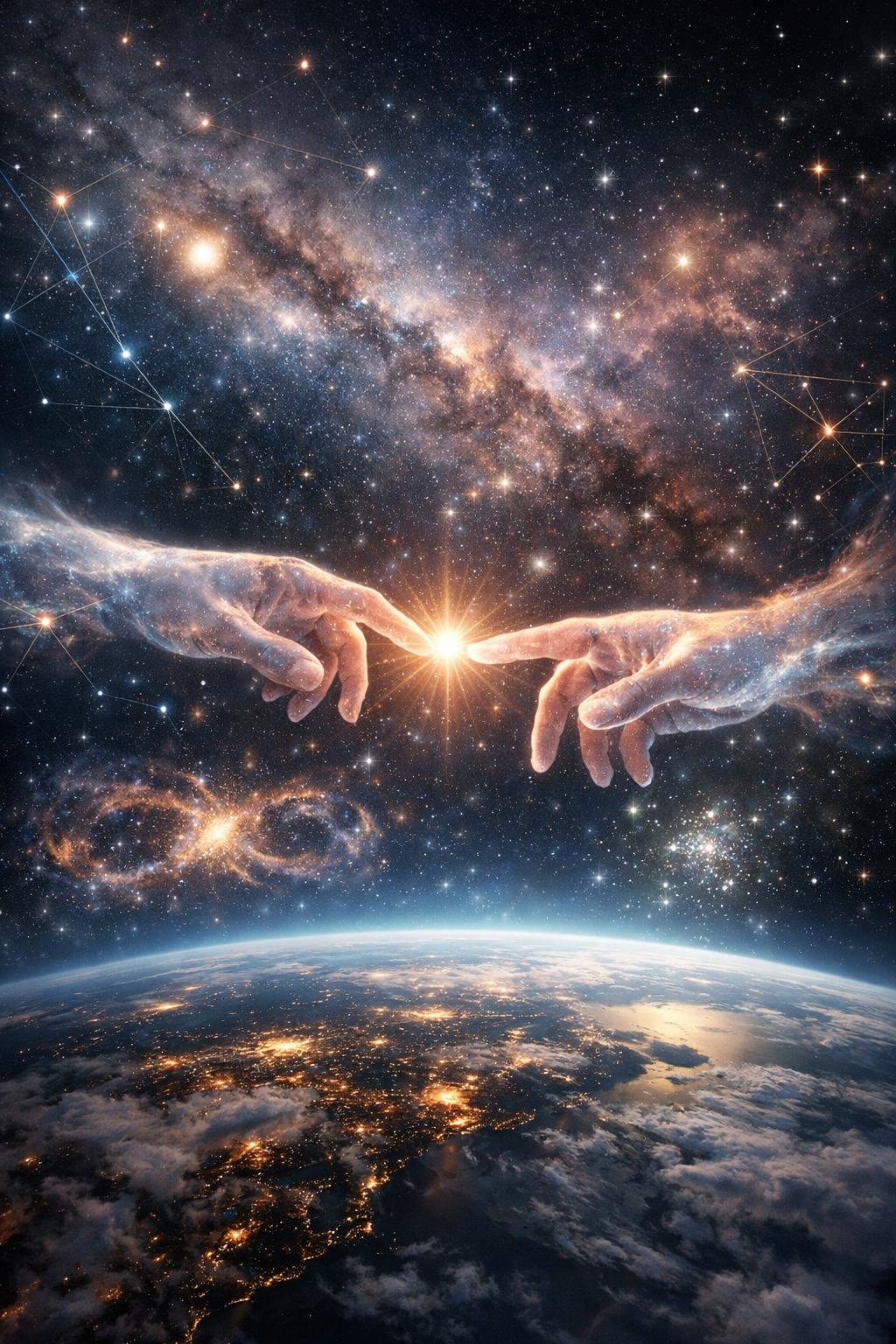
The Surprising Relational Structure of the Universe
By Rev. Peter A. Kerr
We often imagine the universe as an immense stage of solitary objects: planets moving on their own paths, stars burning in distant isolation, galaxies drifting like islands in a silent sea. It can feel cold, indifferent, and fundamentally disconnected. Yet the more deeply we look—through physics, chemistry, biology, and the sciences of mind—the more a different picture emerges.
Instead of separateness, we find relationship. Instead of independence, interdependence. Instead of isolation, surprising forms of cooperation. The building blocks of the cosmos behave far less like lonely particles and far more like partners in an intricate dance.
What if the universe is structured this way on purpose?
If reality is the work of a God revealed in Jesus—a God whose holiness is the fullness of love—then it makes sense that everything from quarks to galaxies would bear faint echoes of that relational source. We do not need to force science into faith or faith into science. We only need to pay attention.
The cosmos is more relational than we think.
Gravity gathers rather than repels
Gravity is often imagined as a crushing force, but its most basic function is gathering. It draws particles together, shapes stars, and holds galaxies in sweeping community. Without gravity’s persistent invitation, matter would drift endlessly, never forming atoms, planets, or a home where life could grow. Literally everything that has mass is pulling everything else that has mass near.
The first force we meet in physics is a force that pulls things toward one another.
Atoms bond rather than remain aloof
The universe does not prefer fragmentation. The simplest atoms join through precise, elegant bonds. Hydrogen and oxygen dance into water. Carbon forms the backbone of life’s architecture. These are not random accidents; they are finely tuned relational possibilities woven into the fabric of reality.
Electric charge—often reduced to plus and minus—is fundamentally about attraction and connection. It is the reason molecules exist at all.
Life thrives through networks, not isolation
Every living cell is a web of relationships—chemical, electrical, informational. Every organism depends on ecosystems, symbiotic partnerships, and flows of energy that tie species and environments together. Even our bodies are not single organisms in the strict sense; they are shared worlds of microbial neighbors that make our digestion, immunity, and vitality possible.
Life is not the triumph of the solitary. It is the victory of integrated complexity.
Consciousness emerges through relationship
Human consciousness, the most astonishing feature of the known universe, arises from connection. Billions of neurons fire in patterns of astonishing coordination. Memory, thought, and emotion are possible only because networks within networks communicate constantly.
The more relational the brain, the more human we become.
And at the deepest level of experience, we discover we were made for relationship. Love is the thing that fulfills us. Isolation is what wounds us. We flourish when we give and receive, connect and trust.
This is not an accident. It is the imprint of something ultimate.
The universe makes more sense if relationship is primary
If ultimate reality were cold, domineering power, we would expect the universe to reflect that: more chaos, more competition, more randomness. Instead, we find fine-tuned constants, intricate order, and an extraordinary bias toward life. We find cooperation hidden in nature’s scaffolding.
Reality behaves as though generosity, connection, and invitation lie at its heart.
This does not prove God in a mathematical sense. It simply suggests that the world looks like the work of a God who creates not out of need, but out of overflowing fullness—the kind of God Jesus reveals.
A God who invites rather than coerces.
A God who gathers rather than scatters.
A God whose power is patient, whose holiness is radiant love.
When Jesus speaks of the Father, He describes a God who is relational to His core—one who sends rain as blessing to the just and unjust, who searches for the lost, who calls the weary to rest, who never forces faith but always invites it. When He speaks of the Spirit, He describes a presence that indwells, guides, comforts, and unites.
If the One who made the cosmos is like this, then the cosmos bearing relational fingerprints should not surprise us.
What this means for us
Seeing the universe this way changes how we experience it.
It restores awe. The world is no longer a random machine; it is a cathedral of connection.
It restores responsibility. We belong to each other more deeply than we realized.
It restores hope. If reality at its roots is relational, then love is not fragile. It is fundamental.
It restores faith. Not blind faith—but a quiet confidence that the God revealed in Jesus has not made a universe hostile to its inhabitants.
We were created for relationship because the world itself is relational. We trust, we love, we seek meaning, not because we are anomalies in an indifferent cosmos, but because we fit the deep structure of things.
An open invitation
Perhaps this is the real surprise. The relational structure of the universe does not merely describe physics or biology; it describes God’s heart. The One who creates connection in atoms and ecosystems extends the same invitation to us.
Come closer.
Live in the light.
Learn the love that shaped the stars.
There is no need to fear a God whose fingerprints are found not in domination but in relationship.
And if that is true, then the universe is far more welcoming—and God far more beautiful—than many of us dared to imagine.