Prayer as Participation: Why God Invites Us to Ask
by Dr. Peter A. Kerr
Prayer is often misunderstood as a way to persuade God to act, to secure outcomes we desire, or to manage uncertainty. In practice, it can quietly become a spiritual lever—something we pull when life feels unstable. Scripture presents prayer very differently. Prayer is not control. Prayer is formation. Prayer is participation.
To understand prayer rightly, we must begin where Scripture begins: God does not owe us anything, yet He gifts us everything. “What do you have that you did not receive?” (1 Corinthians 4:7). Creation itself is gift. Life, breath, time, and redemption are not entitlements; they are grace. Because God is giver rather than debtor, prayer cannot be a claim upon Him. It is an invitation into His life.
This starting point reshapes our expectations. God never promised a life free of trial, disruption, or suffering. He does not spoil His children or shield them from every difficulty. He allows this sin-distorted, misshapen world to remain the place of our formation because this world is not heaven yet. Scripture consistently frames suffering not as evidence of abandonment, but as a means of maturation (James 1:2–4; Hebrews 12:10–11). God’s aim is not immediate comfort, but eternal readiness.
Prayer exists because God is raising a family who will one day reign with Him. This is its deepest purpose. From the beginning, humanity was created to exercise authority under God, not apart from Him (Genesis 1:26–28). Prayer trains this vocation. God does not simply impose His will upon the world because His holiness is not domination but self-giving love. Love must be shared, not forced. Prayer exists because God governs through invitation rather than coercion.
For this reason, God restricts giving us everything we want. He does so not to withhold goodness, but to invite participation. Prayer teaches us to desire what He desires. It draws us into attentiveness, presence, and dependency. Rather than bypassing human agency, God dignifies it. He invites His children to ask Him to bring heaven to earth through shared labor. This is why Jesus teaches us to pray, “Your will be done, on earth as it is in heaven” (Matthew 6:10). Prayer is not about changing God’s mind; it is about aligning ourselves with His will and participating in His love.
This alignment matters because prayer gives us access to real power—not power for self-advancement, but power to love others well. Scripture repeatedly frames prayer as participation in God’s active work rather than passive observation (Ephesians 6:18). Prayer teaches us how to hold power without grasping it, how to desire outcomes without demanding them, and how to act decisively without overriding the freedom of others. These are precisely the capacities required for eternal communion and shared reign.
Christian prayer is therefore always offered “in Jesus’ name.” This phrase is not a ritual formula or spiritual password. To pray in Jesus’ name is to pray according to His character, His mission, and His self-giving love (John 14:13–14). No other prayer is legitimate. A prayer that seeks control, protection of self at all costs, or domination over others may be religious, but it is not Christian. Jesus Himself models true prayer in Gethsemane: “Not my will, but Yours be done” (Luke 22:42).
Because prayer is participation rather than leverage, Scripture insists that every prayer is answered. Not every prayer receives a “yes,” but no prayer is ignored. God’s “no” is as much a gift as His “yes,” because both arise from perfect knowledge and perfect love (2 Corinthians 12:8–9). When an answer does not look like intervention, it is often formation. God may be more present in sustaining, re-orienting, restraining, or strengthening than in changing circumstances.
God also refuses to violate the will of others. For this reason, answers often arrive in ways we did not anticipate and on timelines we would not choose. Still, Scripture invites us to expect that prayer truly matters—that it participates in God’s action within time (James 5:16). Prayer is not symbolic power. It is real power exercised within love’s constraints.
Prayer also releases our grip on control. When we pray, we confess the world does not rest on our competence. Even when tragedy strikes, prayer anchors us in trust: “Cast all your anxiety on Him, because He cares for you” (1 Peter 5:7). This does not mean we understand everything that happens. It means we are not alone within it.
Even death is not the ultimate evil. God’s horizon extends beyond it. Prayer trains us to see beyond immediate outcomes toward God’s eternal purpose—the growth of His family in love (Romans 8:38–39). When we pray, we are not clinging to the present age as though it were final. We are participating in a kingdom that cannot be shaken. We release what we want and accept what He wants is best even for us.
Faith, in this context, is not pretending circumstances are better than they are. Faith is trusting God when His will appears delayed, resisted, or even defeated. Prayer holds hope in place when appearances suggest loss. It trusts that what looks like failure will be redeemed (Hebrews 11:1).
Prayer is participation in real power because one day God intends to entrust His children with real authority in a renewed creation (Revelation 22:5). Prayer is rehearsal for that future. Prayer is essentially pedagogy. It trains us to exercise power as love rather than force.
Never forget: Prayer does not make God more willing. Prayer makes us ready—both to know what He is doing and what He is like while we journey in this world, and more ready to reign with Him in eternity.
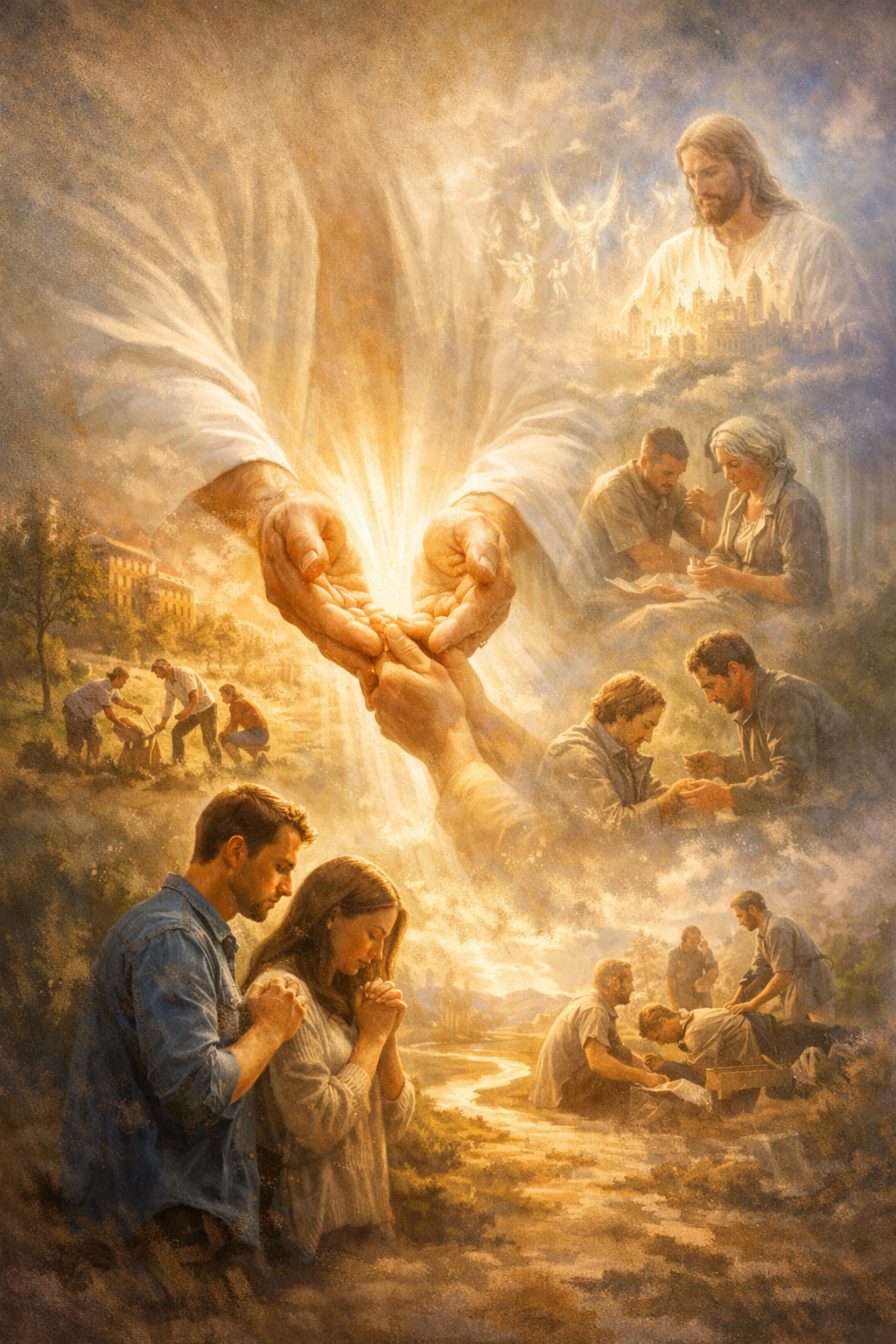
Why God Often Waits for Us to Ask
If God is sovereign, loving, and already committed to the good, why does prayer matter at all? Why does God invite us to ask rather than simply act?
Scripture’s answer is not efficiency, but formation.
God often waits to act—not because He is unwilling, but because He is relational. Prayer is the means by which God draws His children into conscious participation in His work. Asking is not about informing God or persuading Him. It is about aligning our will with His and training us to act as partners rather than spectators.
This is why Scripture consistently links prayer to vigilance, watchfulness, and cooperation. God chooses to work with His people rather than merely around them. When we ask, we step into responsibility. When we pray, we consent to be shaped.
Prayer also clarifies desire. Many requests must be spoken repeatedly not because God has not heard them, but because we have not yet heard ourselves. Over time, prayer exposes whether we want God’s will or simply relief from discomfort. God’s apparent delay is often mercy—it gives space for our loves to be purified.
Importantly, prayer does not override the freedom of others. God’s kingdom advances through invitation, not coercion. This means some prayers unfold slowly, indirectly, or in ways that reshape us more than our circumstances. The delay is not failure. It is the cost of love.
God waits to give because He is teaching us how to receive. He waits to act because He is teaching us how to reign. Prayer is not a workaround for God’s plan. It is one of the primary ways God brings His plan to life—through a people who have learned to ask, to trust, and to love without grasping.
God does not wait because He is uncertain.
He waits because He is forming heirs.
All Scripture is in NASB
1 Corinthians 4:7 “For who regards you as superior? What do you have that you did not receive? And if you did receive it, why do you boast as if you had not received it?”
James 1:2–4 “Consider it all joy, my brethren, when you encounter various trials, knowing that the testing of your faith produces endurance. And let endurance have its perfect result, so that you may be perfect and complete, lacking in nothing.”
Hebrews 12:10–11 “For they disciplined us for a short time as seemed best to them, but He disciplines us for our good, so that we may share His holiness. All discipline for the moment seems not to be joyful, but sorrowful; yet to those who have been trained by it, afterwards it yields the peaceful fruit of righteousness.”
Genesis 1:26–28 “Then God said, ‘Let Us make man in Our image, according to Our likeness; and let them rule over the fish of the sea and over the birds of the sky and over the cattle and over all the earth, and over every creeping thing that creeps on the earth.’ God created man in His own image, in the image of God He created him; male and female He created them. God blessed them; and God said to them, ‘Be fruitful and multiply, and fill the earth, and subdue it; and rule over the fish of the sea and over the birds of the sky and over every living thing that moves on the earth.’”
Matthew 6:10 “‘Your kingdom come. Your will be done, On earth as it is in heaven.’”
Ephesians 6:18 “With all prayer and petition pray at all times in the Spirit, and with this in view, be on the alert with all perseverance and petition for all the saints,”
John 14:13–14 “Whatever you ask in My name, that will I do, so that the Father may be glorified in the Son. If you ask Me anything in My name, I will do it.”
Luke 22:42 “saying, ‘Father, if You are willing, remove this cup from Me; yet not My will, but Yours be done.’”
2 Corinthians 12:8–9 “Concerning this I implored the Lord three times that it might leave me. And He has said to me, ‘My grace is sufficient for you, for power is perfected in weakness.’ Most gladly, therefore, I will rather boast about my weaknesses, so that the power of Christ may dwell in me.”
James 5:16 “Therefore, confess your sins to one another, and pray for one another so that you may be healed. The effective prayer of a righteous man can accomplish much.”
1 Peter 5:7 “casting all your anxiety on Him, because He cares for you.”
Romans 8:38–39 “For I am convinced that neither death, nor life, nor angels, nor principalities, nor things present, nor things to come, nor powers, nor height, nor depth, nor any other created thing, will be able to separate us from the love of God, which is in Christ Jesus our Lord.”
Hebrews 11:1 “Now faith is the assurance of things hoped for, the conviction of things not seen.”
Revelation 22:5 “And there will no longer be any night; and they will not have need of the light of a lamp nor the light of the sun, because the Lord God will illumine them; and they will reign forever and ever.”