The God of Love or the God of Power
By Dr. Peter A. Kerr
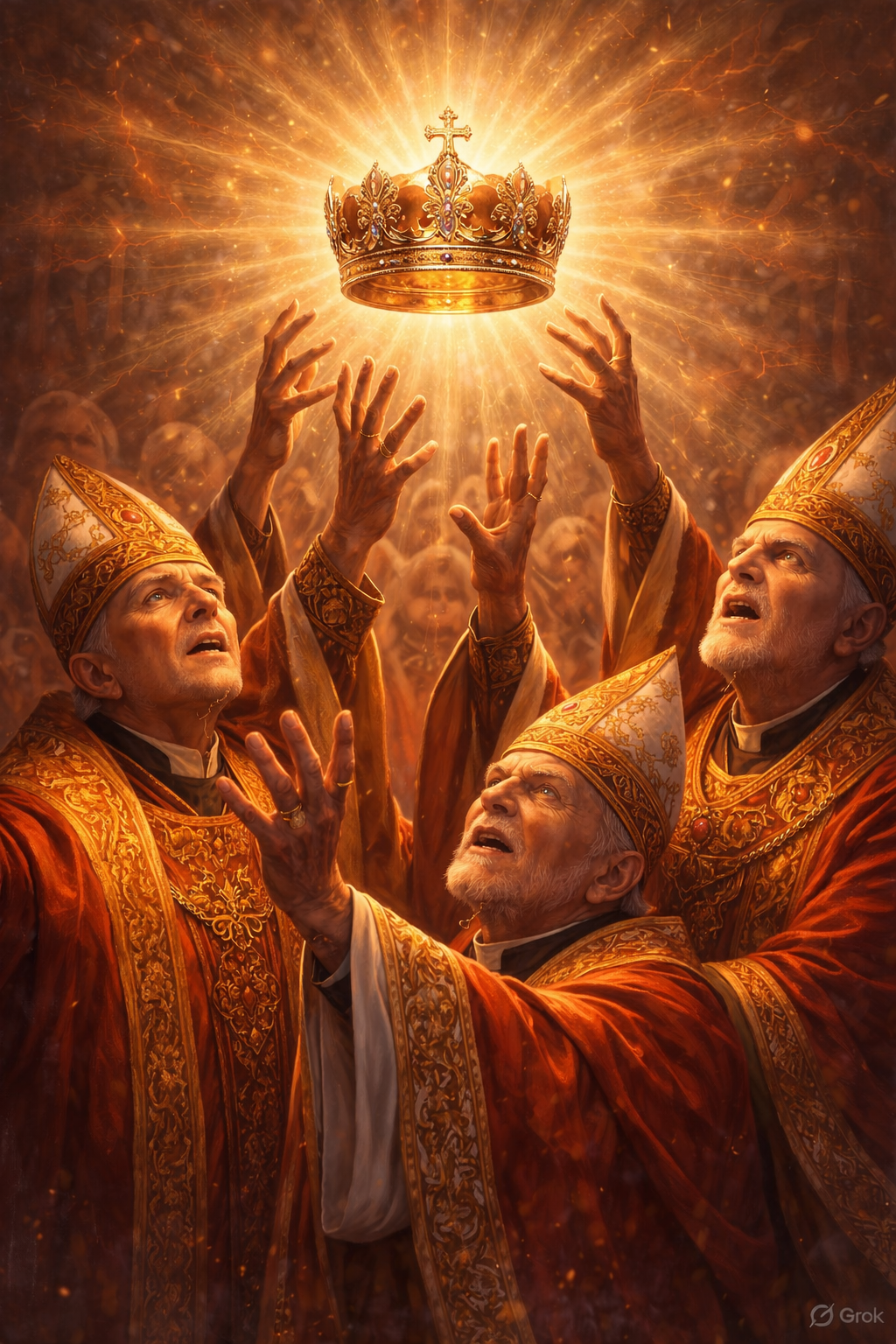
From the earliest days of the Church, the gospel carried within it a quiet but radical claim: God’s kingdom advances not through coercion, force, or domination, but through self-giving love. Jesus did not seize authority; He received it through obedience. He did not rule by compulsion; He reigned by service. Yet history shows how easily this vision can be eclipsed when holiness is confused with power.
In the first centuries, Christian rites such as baptism and communion functioned as signs of participation. They marked entry into a shared life with Christ, not ascent into a ruling class. Baptism signified dying and rising with Christ (Rom 6:3–4), while communion proclaimed dependence, remembrance, and mutual belonging (1 Cor 10:16–17). These practices were never intended as instruments of control but as ordinances of willing submission and identification with the body of Christ.
Over time, however, a shift occurred. As Christianity moved from marginal faith to imperial religion, sacramental authority increasingly became centralized. The rites that once signified shared participation were reinterpreted as mechanisms of mediation. Power slowly relocated from the living Christ present among His people to a clerical class presumed to possess unique access to God. The elements of communion were gradually thought to magically transform into the real body and blood of Christ, but only in the hands of priests. The priesthood of all believers was not explicitly denied, but it was functionally displaced.
Scripture resists this move at every turn. Peter declares without qualification: “You are a chosen race, a royal priesthood, a holy nation” (1 Pet 2:9). Rather than demanding respect for his authority Peter appeals as a “fellow elder” (1 Pet 5:1). The author of Hebrews insists Christ’s priesthood renders all lesser mediations obsolete, for believers may now “draw near with confidence to the throne of grace” (Heb 4:16). Paul refuses hierarchical holiness, insisting that the same Spirit indwells every member of the body (1 Cor 12:4–7).
Building upon this witness, history reveals how a functional power grab emerged when priesthood was redefined as exclusive access rather than shared vocation. Practices that Scripture presents as gifts of participation were gradually reframed as controlled channels of grace. The Bible never speaks of holy water, holy marriage, holy baptism, or even holy communion. These objects and traditions are not imbued with transferable sanctity by priests.
What we lost was the one thing repeatedly called holy: God’s people. The Bible nowhere speaks of being sinners saved by grace: it speaks everywhere and emphatically that we are the saints (holy-ones) saved from sin. God’s people are a holy people, have a holy calling, and serve a holy God who sanctifies by His Spirit.
Baptism marks entry into Christ, communion proclaims dependence upon Him, and marriage images covenantal love, yet none of these require a mediating caste to render God present. When “holy” and “sacred” were co-opted to signify clerical control rather than consecration to God, their meaning was quietly inverted. What had named availability to God was repurposed to restrict it.
Scripture directly contradicts this move by insisting, without qualification, that “there is one God, and one mediator also between God and men, the man Christ Jesus” (1 Tim 2:5). Any priesthood that inserts itself as necessary access does not supplement Christ’s mediation; it competes with it. In doing so, it exchanges relational holiness for institutional power, subtly remaking God not as the One who gives Himself freely, but as One whose presence must be managed, guarded, and dispensed.
When power becomes the hidden telos, theology begins to bend. God is gradually reimagined not as holy love but as sovereign force. Divine will is reframed as unilateral determination. Human freedom is treated as threat rather than gift. In such systems, control masquerades as faithfulness, and submission to authority replaces loving trust. God is no longer the One who persuades, invites, and suffers for His creatures, but the One who ensures outcomes by decree.
In effect, goodness and love are sacrificed on the altar of power. Love is narrowed to compliance. Holiness is reduced to domination. The God revealed in Jesus—who washes feet, weeps over Jerusalem, and refuses the sword—is eclipsed by a god fashioned in the image of empire.
We worship what we love most, and we become transformed into what we worship. The priestly class wanted power and glory, claimed these with “sacraments,” and ended up making a god in their own image who completely determines all things and who seeks glory above all else. This is not merely a theological error; it is a moral one. When power was enthroned, God’s love and holiness were sidelined in Christianity.
Jesus Himself names the danger plainly: “You know that the rulers of the Gentiles lord it over them… but it is not this way among you” (Matt 20:25–26). His kingdom does not imitate the architectures of coercion; it inverts them. Authority in the Church exists only to serve with holy-love, never to replace it. Whenever rites are weaponized, whenever grace is hoarded, whenever God is portrayed as force rather than faithful love, the Church forgets its own priestly identity.
The gospel calls us back. Not to the rejection of sacraments, but to their true meaning. Not to the abolition of leadership, but to its purification. We are not a people formed to wield power over others, but a people shaped to reflect God’s goodness into the world. The royal priesthood is not crowned with control but clothed in humility, bearing witness to a God whose glory is love freely given and freely received.
In the end, the choice before the Church is perennial: to seek glory through power, or to reflect glory through love. History shows how often the former tempts us. Scripture calls us, again and again, to the latter.
Spiritual authority is dangerous precisely because it tempts toward control. Those who teach are judged more strictly because teaching shapes the conscience. True wisdom does not compel compliance; it invites trust. It persuades without coercion and leads without domination. To lead well begins with following God and hearing the Spirit’s voice, and concludes by serving like Christ who laid His own life down for the Church.
Judgement has begun in the house of the Lord. The role of pastor and priest has plummeted in authority and glory. Pastors used to be the most educated and most respected members in town, but now they are often looked at with disdain. While this article has exposed past greed for glory and pining for power, there must also be mention of those servants who did not bow to mammon, who did not succumb to the allure of glory, but who toiled faithfully in the fields of the Lord. To you servants of the Almighty, there can only be un-repayable debt in this life, and incomparable glory in the next.
Let us leave all priestly plays for power and glory, shake off the dominion of the sacerdotal class, and reject conceptualizing God as deterministic dominating force. Let us once again embrace the faith and example of Jesus, who was certainly the King of Kings and the Lion of Judah, but who came as the sacrificial lamb of God. We must reclaim the priesthood of believers, reject language that calls things Holy that are not or that demands another mediator than Jesus our true high priest, and remember: “the wisdom from above is first pure, then peaceable, gentle, reasonable, full of mercy and good fruits, unwavering, without hypocrisy” (James 3:17, NASB).
Scripture Cited Above (all in NASB, 1995)
Romans 6:3–4 Or do you not know that all of us who have been baptized into Christ Jesus have been baptized into His death? Therefore we have been buried with Him through baptism into death, so that as Christ was raised from the dead through the glory of the Father, so we too might walk in newness of life.
1 Corinthians 10:16–17 Is not the cup of blessing which we bless a sharing in the blood of Christ? Is not the bread which we break a sharing in the body of Christ? Since there is one bread, we who are many are one body; for we all partake of the one bread.
1 Peter 2:9 But you are a chosen race, a royal priesthood, a holy nation, a people for God’s own possession, so that you may proclaim the excellencies of Him who has called you out of darkness into His marvelous light;
1 Peter 5:1 Therefore, I exhort the elders among you, as your fellow elder and witness of the sufferings of Christ, and a partaker also of the glory that is to be revealed,
Hebrews 4:16 Therefore let us draw near with confidence to the throne of grace, so that we may receive mercy and find grace to help in time of need.
1 Corinthians 12:4–7 Now there are varieties of gifts, but the same Spirit. And there are varieties of ministries, and the same Lord. There are varieties of effects, but the same God who works all things in all persons. But to each one is given the manifestation of the Spirit for the common good.
1 Timothy 2:5 For there is one God, and one mediator also between God and men, the man Christ Jesus,
Matthew 20:25–26 But Jesus called them to Himself and said, “You know that the rulers of the Gentiles lord it over them, and their great men exercise authority over them. It is not this way among you, but whoever wishes to become great among you shall be your servant,
James 3:17 But the wisdom from above is first pure, then peaceable, gentle, reasonable, full of mercy and good fruits, unwavering, without hypocrisy.