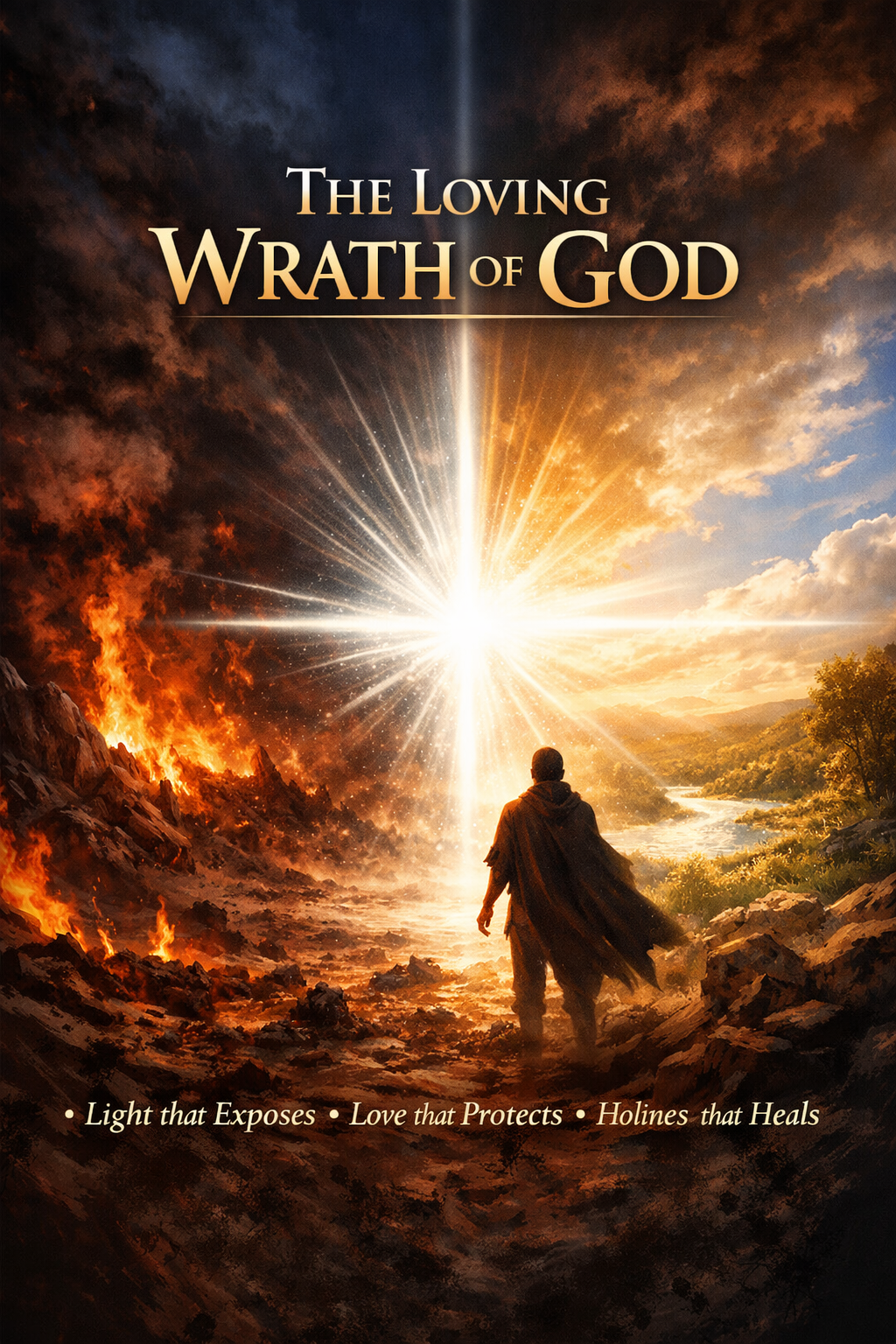
The Loving Wrath of God
by Dr. Peter A. Kerr
Within LUMEN, wrath is not an embarrassment to explain away, nor a contradiction to divine love. Wrath is one of the truthful forms holy-love must take in a fractured world. It is what love looks like when goodness, truth, and love meet destruction that threatens persons, communities, and creation.
God’s holiness is not severity. It is plenitude. Scripture presents God as radiant fullness: perfect goodness, unwavering truth, and inexhaustible love existing in eternal unity. Because this holiness is undivided, every divine action rises from the same source. God does not swing between mercy and anger, patience and fury, kindness and violence. The divine motive does not change. What changes is the posture of the creature who encounters that holiness.
Wrath, therefore, is not a competing attribute alongside love. It is holy-love responding rightly to all that corrodes communion.
Why Love Must Sometimes Oppose
If holy-love is the union of goodness, truth, and love, then it must include real consequences for whatever opposes it. Goodness and life do more than bestow beauty. They banish evil and ugliness, and one day death itself will be thrown into the lake of fire (Revelation 20:14). The light of truth does more than illuminate. It exposes, reveals, and eradicates lies and deception. Darkness cannot coexist with light. Love does more than affirm. It protects, exposes selfishness, and encourages maturation. Love resists whatever destroys the beloved.
A God who never confronts is not loving but indifferent. Scripture repeatedly shows that God’s love is morally serious. It seeks the flourishing of persons and the preservation of life. When evil threatens that flourishing, love must oppose it or become complicit in its harm.
Wrath names the moment when holy-love refuses to let destruction proceed unchecked. It is goodness drawing a boundary. It is truth unveiling what hides in darkness. It is love refusing to abandon the vulnerable.
This is why Scripture so often pairs divine wrath with God’s slowness to anger (Psalm 103:8; Exodus 34:6). Wrath does not arise from impatience or volatility. It arises because patience has been extended and refused. God’s delay is mercy. God’s intervention is protection and justice.
Light Experienced as Heat
Divine action is best understood through the metaphor of light rather than force. God is light in the biblical sense: revealing, life-giving, clarifying, and non-coercive. Light does not impose itself violently, yet it is never neutral. Light exposes. When focused, light can become a laser, one of the mightiest forces in the world.
A receptive soul experiences soft light as illumination and healing. A resistant soul experiences that same light as discomfort, threat, or pain. The difference is not in the light, but in the orientation of the mirror of the soul. The same radiance that would have healed now burns. The pain arises from misalignment, not malice.
This preserves divine consistency. God does not change. Love remains what it has always been. Wrath names the creature’s experience of that unchanging holiness when communion is refused.
Wrath as Protection, Not Temper
Scripture often depicts wrath as God’s response in defense of the weak. This is not incidental. A God who loves all must protect those being crushed by another’s will. Wrath emerges when continued patience toward the perpetrator would become cruelty toward the victim. At that point, love must intervene. To refuse to act would not be mercy but abandonment.
This is why biblical wrath often first appears as restraint, exposure, and interruption. Evil is limited. Violence is checked. Injustice is brought into the light. These acts are not the withdrawal of love, but its intensification. Love becomes severe only because the situation has become severe.
Wrath as judgment, like hardening, also protects the perpetrator from deeper self-corruption by bringing the time of rebellion to an end. Every act of evil distorts the soul further, incurring further ultimate pain in Hell. By confronting and limiting destructive behavior, holy-love resists the sinner’s descent into greater harm. Even judgment in this life often carries a medicinal aim: to arrest a trajectory before it becomes irreversible.
Wrath and the Cross
The Bible never says God pours out His wrath upon Jesus at the cross. Despite poems and songs that speak that way, God does not vent anger onto an innocent victim. A better way to understand Calvary is to see Jesus bringing all the death, darkness, and sin of mankind into exposure before God’s light.
Jesus entered the full weight of human evil, absorbed it without retaliation, and gave it all to the Father. God’s wrath was directed against sin and evil, not against the second Person of the Godhead. Death, the last enemy, is what is truly being judged and expunged in the Person of Jesus.
God said to Adam that in the day he ate from the tree of the knowledge of good and evil, “you will surely die” (Genesis 2:17). That pronouncement gave the accuser, Satan, the right to demand death for humanity. God always keeps His word, so when the fruit was eaten, the sentence of death was passed. The immediate effects were, first, pain entering the world (Genesis 3:16), a kind of prolonged dying and a signal that life is under threat; second, the physical death of humanity began, and Adam’s days started to count down (Genesis 5:5). The spiritual death of separation from the God who is Life, however, was commuted until Jesus could bear it on our behalf.
At the cross the full price of sin was paid. However, the large but still finite amount of death mankind owed was less than the infinite Life of Jesus. All darkness was judged by exposure to God’s light, and the darkness was blown away. Jesus does not evade wrath. He exhausts it as He exhausts death, while refusing to participate in its logic.
Here wrath and mercy meet without contradiction. God confronts sin by bearing its cost. Justice is not denied. It is fulfilled through love rather than imposed through domination.
We must reject two common distortions of wrath: denial and domination. Denial dissolves wrath into sentimentality. A God who never resists evil is not loving but negligent. Domination portrays wrath as coercive violence imposed from above. A God who rules by terror contradicts the character revealed in Christ.
Wrath belongs to neither distortion. It is neither indulgent nor tyrannical. It is morally lucid love acting faithfully within the reality human choices have created. Wrath does not negate freedom. It honors freedom’s weight. Choices matter. They shape persons, communities, and histories. Wrath allows those choices to be truthfully disclosed rather than endlessly deferred.
Just as the sentence of death was commuted, so also the pronouncement of life for all is delayed. Just as Adam acted as the gateway for sin to enter the human domain, so at the cross Jesus acted as the gateway to life for all who repent and believe (Rom 5:12-21). The spiritual victory was won at the cross, and the victory over pain and physical death will come when Jesus returns (Rev 21:4).
Scripture Referenced (in NAS)
Revelation 20:14 Then Death and Hades were thrown into the lake of fire. This is the second death, the lake of fire.
Psalm 103:8 The LORD is compassionate and gracious, Slow to anger and abounding in mercy.
Exodus 34:6 Then the LORD passed by in front of him and proclaimed, “The LORD, the LORD God, compassionate and merciful, slow to anger, and abounding in faithfulness and truth.”
Genesis 2:17 but from the tree of the knowledge of good and evil you shall not eat, for on the day that you eat from it you will certainly die.
Genesis 3:16 To the woman He said, “I will greatly multiply Your pain in childbirth, In pain you shall deliver children; Yet your desire will be for your husband, And he shall rule over you.”
Genesis 5:5 So all the days that Adam lived were 930 years, and he died.
Romans 5:12-21 Therefore, just as through one man sin entered into the world, and death through sin, and so death spread to all mankind, because all sinned— (for until the Law sin was in the world, but sin is not imputed when there is no law. Nevertheless death reigned from Adam until Moses, even over those who had not sinned in the likeness of the offense of Adam, who is a type of Him who was to come. But the gracious gift is not like the offense. For if by the offense of the one the many died, much more did the grace of God and the gift by the grace of the one Man, Jesus Christ, abound to the many. ... So then, as through one offense the result was condemnation to all mankind, so also through one act of righteousness the result was justification of life to all mankind. For as through the one man’s disobedience the many were made sinners, so also through the obedience of the One the many will be made righteous.)
Revelation 21:4 and He will wipe away every tear from their eyes; and there will no longer be any death; there will no longer be any mourning, or crying, or pain; the first things have passed away.