Perfectly Free Human Will: God Refuses to Destroy His Image in Us
By Dr. Peter A. Kerr
One of the correct quiet assumptions beneath much Christian theology is that God restrains Himself out of respect for human freedom. God for some reason honors the human will, even when it resists Him. While this instinct points in the right direction, it does not go far enough. Within the vision articulated here, God does not refrain from coercing human will merely because He respects human autonomy. God refuses to coerce because doing so would destroy His own image in us.
Scripture presents the image of God not as a detachable property but as a vocation and capacity: humanity is created “in the image of God” to reflect His character into the world (Gen 1:26–27). That image is never described as revoked after the Fall. Even after human violence fills the earth, God still grounds human dignity in the enduring image (Gen 9:6). The New Testament deepens this vision by identifying the image with Christ Himself, “the image of the invisible God” (Col 1:15), into whose likeness humanity is being restored (Rom 8:29; 2 Cor 3:18).
To image God is to be able to receive love freely and to offer love freely in return. Scripture consistently treats love as something that cannot be compelled: “Love does not insist on its own way” (1 Cor 13:5). This capacity for free response is not incidental to creation. It is its purpose. If God were to override the human will, He would not be protecting His image. He would be annihilating it.
This reframes divine restraint entirely. God is not politely stepping back. He is being faithful to Himself. Scripture repeatedly affirms God cannot act against His own nature: “God cannot deny Himself” (2 Tim 2:13), and “it is impossible for God to lie” (Heb 6:18). Love cannot be forced without ceasing to be love. Since “God is love” (1 John 4:8), coercion would amount to divine self-contradiction. God does not lack the power to compel. He lacks the desire to destroy what He created to reflect Him.
Seen this way, the long-standing tension between divine sovereignty and human freedom dissolves rather than compromises. God remains fully sovereign, not in spite of His refusal to coerce, but precisely because of it. Scripture consistently portrays God as accomplishing His purposes without violating the will: “He works all things according to the counsel of His will” (Eph 1:11), yet He pleads, invites, and reasons rather than forces (Isa 1:18; Ezek 18:31–32). Divine power serves divine love. Omnipotence does not include the power to negate God’s own holiness.
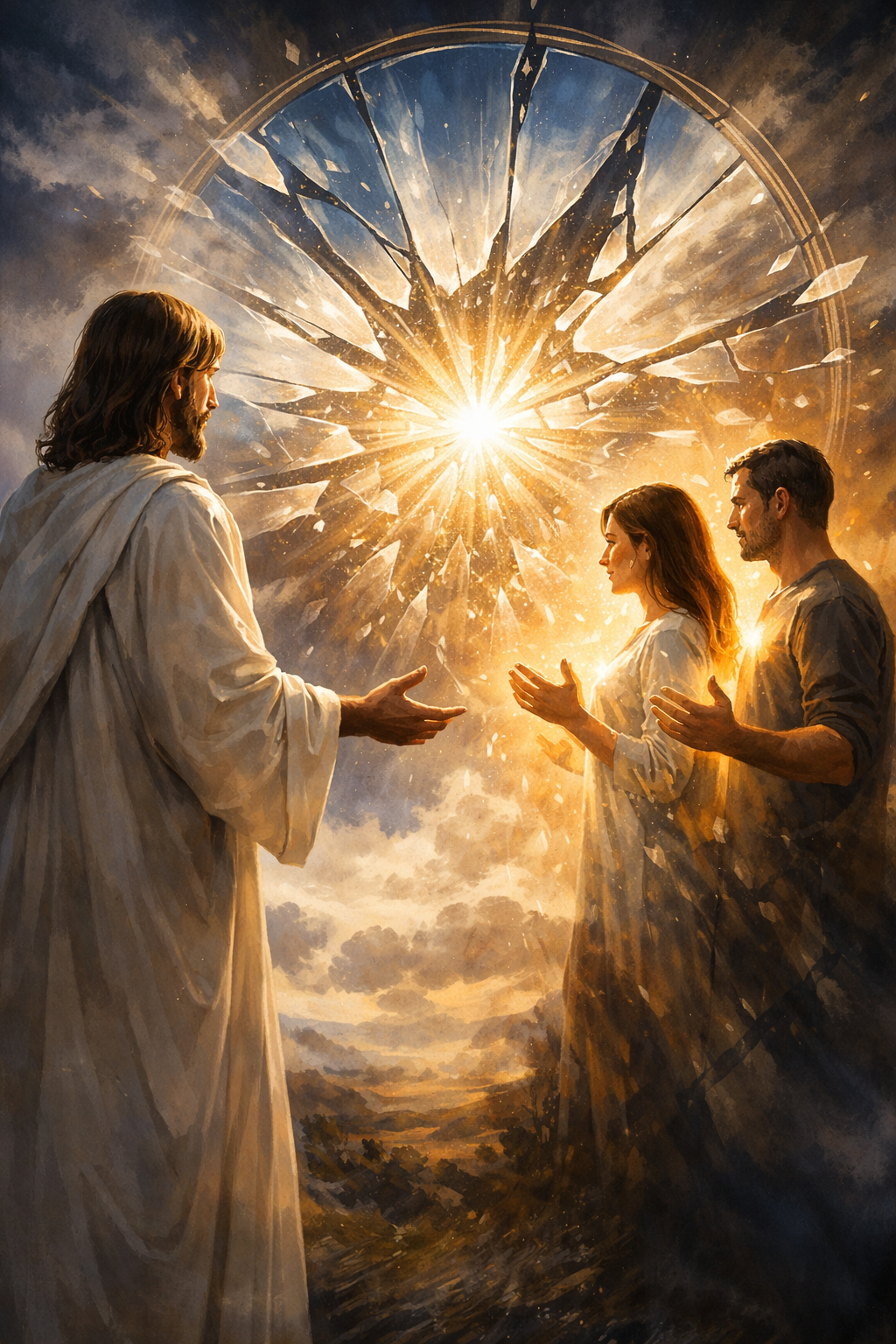
This insight also clarifies the meaning of freedom. Human freedom is not preserved because it is independently sacred. It is preserved because it is the mirror through which God’s holy-love is meant to shine. Scripture frames obedience as something God desires rather than demands: “Choose this day whom you will serve” (Josh 24:15), “Turn to Me and live” (Ezek 18:32), “How often I wanted to gather your children together… and you were unwilling” (Matt 23:37). To force the will would be to shatter the mirror.
The life of Jesus makes this unmistakably clear. Christ does not override resistance. He absorbs it. He invites disciples to follow Him rather than compelling them (Matt 4:19; John 1:39). He allows some to walk away when His words offend rather than revising them to secure allegiance (John 6:66–67). He refuses to prove Himself by force even when challenged to do so (Matt 4:5–7; 27:40–43). At the cross, God does not seize control to guarantee obedience. He endures the violent misuse of human freedom rather than destroy the image He came to heal (Isa 53:3–7; Phil 2:6–8).
Judgment follows the same logic. Scripture does not portray judgment as God finally becoming coercive. It is consistently described as revelation: “Nothing is hidden that will not be disclosed” (Luke 8:17), “each one’s work will become manifest, for the Day will disclose it” (1 Cor 3:13), “all things are open and laid bare before Him” (Heb 4:13). God’s posture does not change. The same holy presence is experienced as joy by those aligned with love and as anguish by those who resist it (John 3:19–21). God remains light. The difference lies in reception.
Faith now appears in its proper place. Faith is not a workaround for insufficient evidence. It is the necessary condition for love to remain love. Scripture explicitly links faith with freedom and relationship rather than compulsion: “Without faith it is impossible to please God” (Heb 11:6), not because God withholds clarity, but because trust preserves relational space. God gives enough light to invite response, not so much as to override it (John 20:29). Faith protects the image by preserving the possibility of genuine response.
This reshapes prayer, obedience, and formation. Prayer is no longer an attempt to leverage outcomes but participation in God’s self-giving life (Matt 6:10; Rom 8:26–27). Obedience becomes trust rather than compliance under threat: “If you love Me, you will keep My commandments” (John 14:15). Formation becomes transformation of the will rather than management of behavior: “Be transformed by the renewing of your mind” (Rom 12:2), “work out your salvation… for God is at work in you” (Phil 2:12–13).
God’s refusal to coerce is not weakness. It is strength of a different order. Scripture consistently associates divine strength with patience, restraint, and mercy rather than domination: “The Lord is slow to anger and great in power” (Nahum 1:3), “Love is patient” (1 Cor 13:4), “The kindness of God leads you to repentance” (Rom 2:4). God refuses to destroy His image in us, even when we misuse it, because that image is the very means by which His love is meant to fill the world.
Christianity does not stand or fall on how much control God exerts. It stands on who God is. A God who is holy-love will never save the world by destroying the very capacity through which love becomes real. To force human will is to destroy love, and God is love—He will not destroy Himself.

All Scripture is in NASB
Genesis 1:26–27 Then God said, “Let Us make man in Our image, according to Our likeness; and let them rule over the fish of the sea and over the birds of the sky and over the cattle and over all the earth, and over every creeping thing that creeps on the earth.” God created man in His own image, in the image of God He created him; male and female He created them.
Genesis 9:6 Whoever sheds man’s blood, By man his blood shall be shed, For in the image of God He made man.
Colossians 1:15 He is the image of the invisible God, the firstborn of all creation.
Romans 8:29 For those whom He foreknew, He also predestined to become conformed to the image of His Son, so that He would be the firstborn among many brethren.
2 Corinthians 3:18 But we all, with unveiled face, beholding as in a mirror the glory of the Lord, are being transformed into the same image from glory to glory, just as from the Lord, the Spirit.
1 Corinthians 13:5 does not act unbecomingly; it does not seek its own, is not provoked, does not take into account a wrong suffered.
2 Timothy 2:13 If we are faithless, He remains faithful, for He cannot deny Himself.
Hebrews 6:18 so that by two unchangeable things in which it is impossible for God to lie, we who have taken refuge would have strong encouragement to take hold of the hope set before us.
1 John 4:8 The one who does not love does not know God, for God is love.
Ephesians 1:11 also we have obtained an inheritance, having been predestined according to His purpose who works all things after the counsel of His will.
Isaiah 1:18 “Come now, and let us reason together,” Says the Lord, “Though your sins are as scarlet, They will be as white as snow; Though they are red like crimson, They will be like wool.”
Ezekiel 18:31–32 Cast away from you all your transgressions which you have committed and make yourselves a new heart and a new spirit! For why will you die, O house of Israel? For I have no pleasure in the death of anyone who dies,” declares the Lord God. “Therefore, repent and live.”
Joshua 24:15 If it is disagreeable in your sight to serve the Lord, choose for yourselves today whom you will serve: whether the gods which your fathers served which were beyond the River, or the gods of the Amorites in whose land you are living; but as for me and my house, we will serve the Lord.
Matthew 23:37 “Jerusalem, Jerusalem, who kills the prophets and stones those who are sent to her! How often I wanted to gather your children together, the way a hen gathers her chicks under her wings, and you were unwilling.”
Matthew 4:19 And He said to them, “Follow Me, and I will make you fishers of men.”
John 1:39 He said to them, “Come, and you will see.” So they came and saw where He was staying; and they stayed with Him that day, for it was about the tenth hour.
John 6:66–67 As a result of this many of His disciples withdrew and were not walking with Him anymore. So Jesus said to the twelve, “You do not want to go away also, do you?”
Matthew 4:5–7 Then the devil took Him into the holy city and had Him stand on the pinnacle of the temple, and said to Him, “If You are the Son of God, throw Yourself down; for it is written, ‘He will command His angels concerning You’; and ‘On their hands they will bear You up, So that You will not strike Your foot against a stone.’” Jesus said to him, “On the other hand, it is written, ‘You shall not put the Lord your God to the test.’”
Matthew 27:40–43 and saying, “You who are going to destroy the temple and rebuild it in three days, save Yourself! If You are the Son of God, come down from the cross.” In the same way the chief priests also, along with the scribes and elders, were mocking Him and saying, “He saved others; He cannot save Himself. He is the King of Israel; let Him now come down from the cross, and we will believe in Him. He trusts in God; let God rescue Him now, if He delights in Him; for He said, ‘I am the Son of God.’”
Isaiah 53:3–7 He was despised and forsaken of men, A man of sorrows and acquainted with grief; And like one from whom men hide their face He was despised, and we did not esteem Him. Surely our griefs He Himself bore, And our sorrows He carried; Yet we ourselves esteemed Him stricken, Smitten of God, and afflicted. But He was pierced through for our transgressions, He was crushed for our iniquities; The chastening for our well-being fell upon Him, And by His scourging we are healed. All of us like sheep have gone astray, Each of us has turned to his own way; But the Lord has caused the iniquity of us all To fall on Him. He was oppressed and He was afflicted, Yet He did not open His mouth; Like a lamb that is led to slaughter, And like a sheep that is silent before its shearers, So He did not open His mouth.
Philippians 2:6–8 who, although He existed in the form of God, did not regard equality with God a thing to be grasped, but emptied Himself, taking the form of a bond-servant, and being made in the likeness of men. Being found in appearance as a man, He humbled Himself by becoming obedient to the point of death, even death on a cross.
Luke 8:17 For nothing is hidden that will not become evident, nor anything secret that will not be known and come to light.
1 Corinthians 3:13 each man’s work will become evident; for the day will show it because it is to be revealed with fire, and the fire itself will test the quality of each man’s work.
Hebrews 4:13 And there is no creature hidden from His sight, but all things are open and laid bare to the eyes of Him with whom we have to do.
John 3:19–21 This is the judgment, that the Light has come into the world, and men loved the darkness rather than the Light, for their deeds were evil. For everyone who does evil hates the Light, and does not come to the Light for fear that his deeds will be exposed. But he who practices the truth comes to the Light, so that his deeds may be manifested as having been wrought in God.
Hebrews 11:6 And without faith it is impossible to please Him, for he who comes to God must believe that He is and that He is a rewarder of those who seek Him.
John 20:29 Jesus said to him, “Because you have seen Me, have you believed? Blessed are they who did not see, and yet believed.”
Matthew 6:10 Your kingdom come. Your will be done, On earth as it is in heaven.
Romans 8:26–27 In the same way the Spirit also helps our weakness; for we do not know how to pray as we should, but the Spirit Himself intercedes for us with groanings too deep for words; and He who searches the hearts knows what the mind of the Spirit is, because He intercedes for the saints according to the will of God.
John 14:15 “If you love Me, you will keep My commandments.”
Romans 12:2 And do not be conformed to this world, but be transformed by the renewing of your mind, so that you may prove what the will of God is, that which is good and acceptable and perfect.
Philippians 2:12–13 So then, my beloved, just as you have always obeyed, not as in my presence only, but now much more in my absence, work out your salvation with fear and trembling; for it is God who is at work in you, both to will and to work for His good pleasure.
Nahum 1:3 The Lord is slow to anger and great in power, And the Lord will by no means leave the guilty unpunished. In whirlwind and storm is His way, And clouds are the dust beneath His feet.
1 Corinthians 13:4 Love is patient, love is kind and is not jealous; love does not brag and is not arrogant.
Romans 2:4 Or do you think lightly of the riches of His kindness and tolerance and patience, not knowing that the kindness of God leads you to repentance?