Why God Uses Faith not Sight
By Dr. Peter A. Kerr
Faith is often treated as something we either possess or lack. At times it is reduced to willpower—the effort to believe despite insufficient evidence. Scripture and lived experience suggest something far richer. Faith is not a quantity to accumulate, nor a leap taken in darkness. Faith is a way of seeing reality deeply and rightly—it is learning to live in alignment with what is most real. Faith is not the absence of sight, but belief in God that grants insight into the truest contours of reality (Heb 11:1; Eph 1:18; 2 Cor 5:7).
Faith matures not by trying harder to believe, but by undergoing a gradual reordering of perception. It begins with learning what God treats as ultimate. It proceeds through small, often unnoticed steps of trust in action. Only much later does it grow confident enough to entrust itself fully to a God who has never failed to catch those who fall into His care.
God does not regard circumstances or even physical things as ultimate. This world is His playground, and just as we can manipulate pixels in a video game, He has no trouble moving around the features that make up our surroundings when doing so furthers His purpose of loving.
He does not do it often because constant intervention would erode our confidence in His created order, destroying science which is based upon the Christian insistence that there are natural laws and so repeatability and stability. He made things as they are for a purpose. Most importantly, God does not simply bend reality to our every whim because He refuses to spoil His children. The world as playground was made to mature us, and while we may need to endure some bumps and bruises playing here, it is worth the reward of growth that can be accomplished.
The Image of God As the Ultimate Reality in Creation
God regards His image—the human capacity to be holy—as the ultimate reality in creation. He refuses to coerce human will out of respect for His image in us. Human will is therefore fully autonomous so we can choose to love, refuse, and trust. God never violates this capacity—ever. To do so would be to destroy His crowning creation, to uncreate the purpose of creation, and to even destroy His own image.
God made room within Himself for creation in order to mature an eternal family. Because He is the all-in-all, He must have created within Himself rather than apart from Himself. The human soul can both receive His self-gift of holy-love and choose to reflect holy-love back to God and the world.
The more we have an ability to choose the more powerfully we can choose to reflect God’s love. If I program my computer to greet me when I return home there is no love. If my dog comes to greet me there is some love. If my wife stops what she is doing to give me a hug, there is a lot of love because she has the most free will.
This is also why Christ’s disciples have always practiced spiritual disciplines—to increase the power of the will to choose the good. Physical discipline is of some value, but spiritual discipline has value in all things (1 Tim 4:8). Discipline is denial of the self in the present for future gain. It lies at the center of discipleship.
God shapes rather than compels human decisions. He invites rather than coerces. He exposes, calls, and waits. Divine omnipotence and sovereignty are never in question. What is misunderstood is divine purpose. God’s power serves love, not the other way around. God first freely offers Himself, and then He allows love to be freely offered back. “We love because He first loved us” (1 John 4:19). If you love little then you should ask God to show you His love for you.
God’s granting and protecting human freedom to love equips us with something to give back. Our freely chosen love is a gift to Him that He doesn’t automatically have precisely because He refuses to compel it. To force human will is to destroy love, and God is love—He will not destroy Himself.
Furthermore, coercion would contradict love itself because it would become a taking for the self rather than a giving of the self. Scripture consistently associates coercion, addiction, and possession not with God, but with the adversary. God frees, invites, and indwells. He is so loving that He allows us to each day make a new decision to love—we are daily invited to take up our cross and follow Him (Luke 9:23). Faith grows precisely in that space of repeated invitation.
To grow in faith is to learn to see other people as God sees them: not as problems to solve, levers to pull, or outcomes to manage, but as irreducible centers of freedom that are capable of reflecting God’s holy-love. Faith refuses the illusion that hearts can be engineered and people are to be manipulated or bullied. It accepts the costliness of patience, the dignity of refusal, the preciousness of the ability to choose. God’s goal is to have an eternal family so He is maturing the human will.
The Ephemeral Character of Material Creation
At the same time, faith learns to see physical reality differently. The material world is real, but it is not ultimate. It is the dance floor, not the dancer. God reshapes circumstances rather than human will. He opens and closes doors, rearranges histories, delays outcomes, shines extra light, and redeems loss—not as arbitrary displays of power, but as ways of creating space in which love may freely grow.
Unbelief treats circumstances as fixed and people as malleable. Faith reverses that order. Faith knows hearts cannot be forced, but situations are endlessly adjustable in the hands of holy-love.
This is why faith is not threatened by unanswered prayer. Prayer aimed at controlling outcomes quietly undermines faith. God is not reluctant to change the dance floor of the material world, but He is resolute about forming all dancers. Faith rests in this priority. It trusts God is never inactive, even when nothing visibly changes. Faith matures through sustained exposure to unresolved light.
God rarely overwhelms. He gives enough illumination to invite trust, but not enough to eliminate freedom. If God made Himself visible we would be compelled by His presence to worship, or to obey from self-preservation, or worse, out of a selfish desire for gain. Even now with the space afforded by faith some people only believe to get the reward of Heaven instead of to receive the Presence of God. They in effect love themselves by wanting God’s house more than His company, and they mistakenly think their selfishness is saving faith. Faith protects love by preserving space for genuine response, and no person who supremely loves themselves truly reflects God’s love.
Once we are in the center of His will we start to see the ephemeral nature of the material world. As trust deepens and we expect rather than just wish for Him to act, He can do so without compulsion or spoiling us. If we already believe there is no compulsion from His self-revelation. When we ask not for selfish gain but in Jesus’ name and for His sake we are often granted miracles. Praying “in Jesus’ name” includes submitting to His solutions and timelines, even when it looks like a rejection of our voiced desires.
When we believe and do not doubt, and when the person we are acting to bless believes and so is also not being compelled, then amazing things can happen. We are promised we can do even greater things than Jesus did (John 14:12) and that with even the faith of a mustard seed we can move mountains (Matt 17:20).
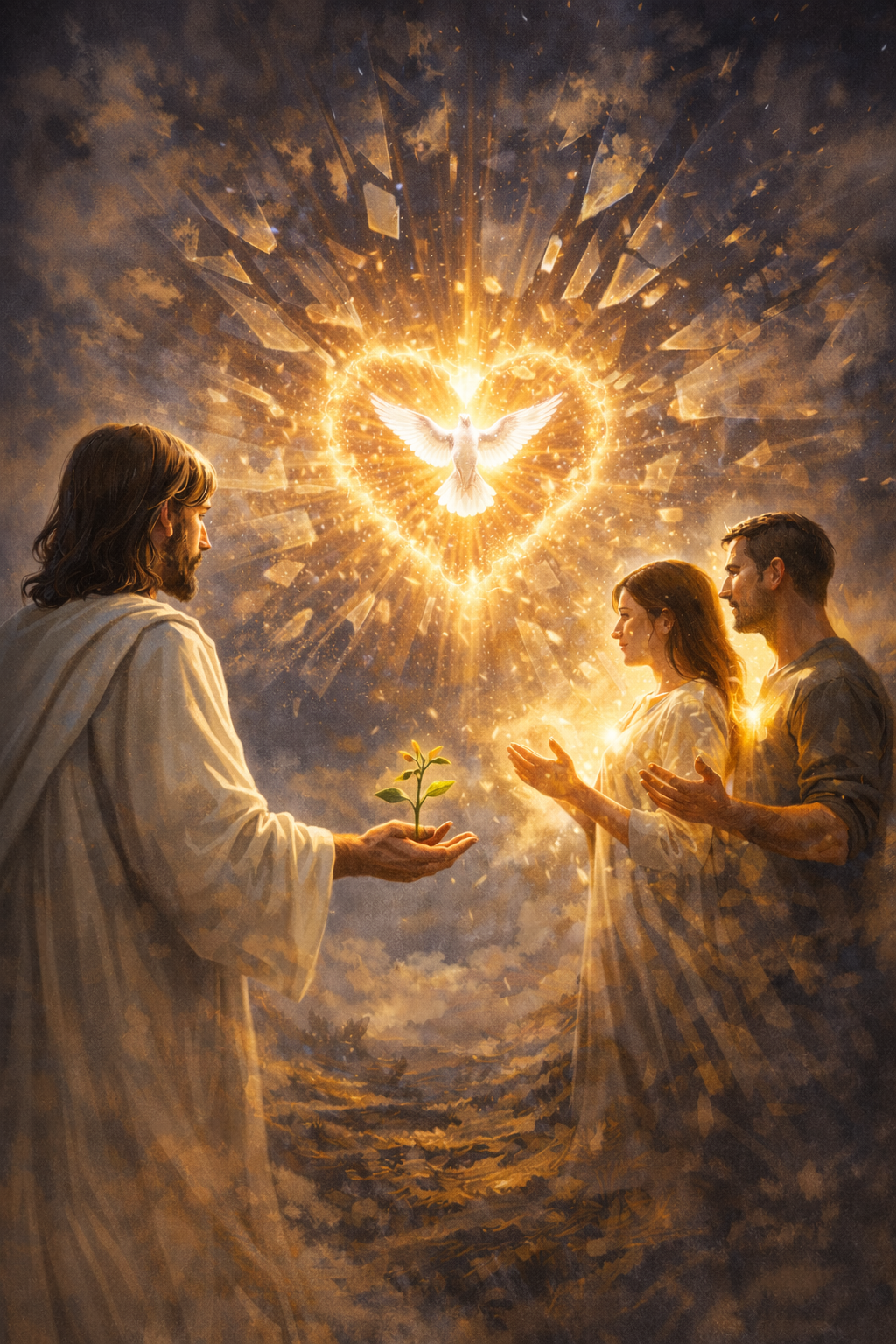
Faith, then, is not God’s substitute for sight but His protection of love. It is the space in which the image of God remains intact, the will remains free, and holiness remains possible. God uses faith not because He is distant, but because He is faithful—to His own nature, to His purposes, and to the image He has placed within us. Faith does not make reality weaker; it makes love real. Where faith is allowed to mature, control loosens, fear recedes, and holy-love finds room to grow—quietly, freely, and eternally.
All Scripture is in NASB
Hebrews 11:1 Now faith is the assurance of things hoped for, the conviction of things not seen.
Ephesians 1:18 I pray that the eyes of your heart may be enlightened, so that you will know what is the hope of His calling, what are the riches of the glory of His inheritance in the saints.
2 Corinthians 5:7 for we walk by faith, not by sight.
1 Timothy 4:8 for bodily discipline is only of little profit, but godliness is profitable for all things, since it holds promise for the present life and also for the life to come.
1 John 4:19 We love, because He first loved us.
Luke 9:23 And He was saying to them all, “If anyone wishes to come after Me, he must deny himself, and take up his cross daily and follow Me.”
John 14:12 Truly, truly, I say to you, he who believes in Me, the works that I do, he will do also; and greater works than these he will do; because I go to the Father.
Matthew 17:20 And He said to them, “Because of the littleness of your faith; for truly I say to you, if you have faith the size of a mustard seed, you will say to this mountain, ‘Move from here to there,’ and it will move; and nothing will be impossible to you.”