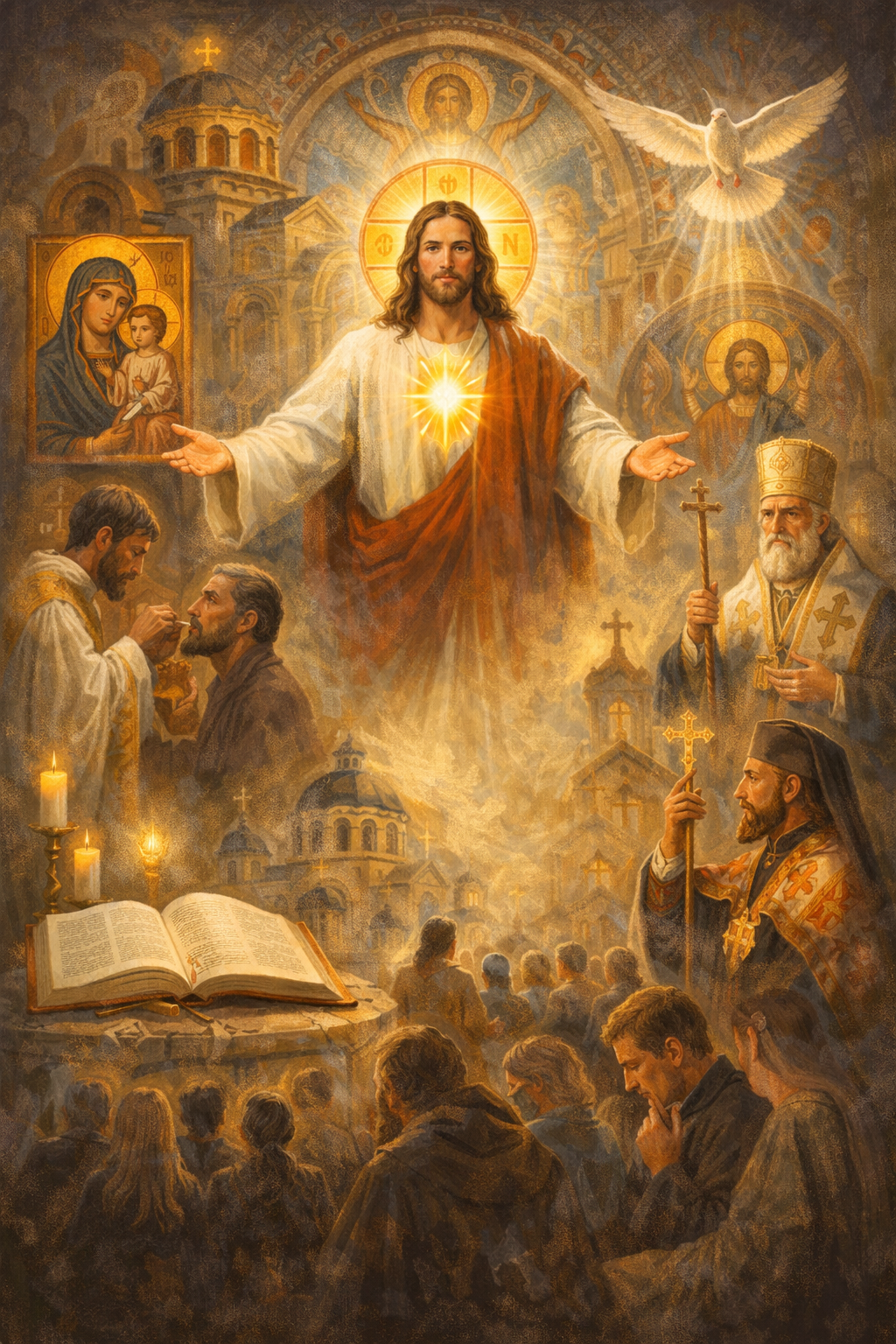
LUMEN and Eastern Orthodox
by Dr. Peter A.Kerr
Eastern Orthodox theology has long spoken of salvation not primarily as a legal transaction, but as participation in divine life. Its language of theosis—becoming “partakers of the divine nature” (2 Pet 1:4)—does not suggest humans become God by essence, but that they are healed, illumined, and drawn into communion with God by grace. In this vision, LUMEN finds a deep resonance.
LUMEN approaches Eastern Orthodoxy with gratitude rather than correction. Where Orthodoxy has preserved a participatory, relational, and doxological grammar of salvation, it has guarded essential biblical truth. LUMEN does not seek to replace this grammar, but to articulate it in a way that speaks across traditions while remaining anchored in Scripture and centered on Christ.
Salvation as Healing and Participation
Orthodox theology consistently frames salvation as healing rather than merely acquittal. Sin is understood less as the breaking of an external law and more as a sickness of the soul—a distortion of desire, perception, and love. Scripture itself often speaks this way. Humanity is described as needing illumination (Eph 1:18), restoration (Acts 3:21), and transformation (Rom 12:2). Christ comes not only to forgive sins, but to heal what sin has disordered.
LUMEN shares this therapeutic vision. Sin is not an ontological erasure of the image of God, but a misalignment of it. Humanity remains capable of communion because the image endures (Gen 9:6; James 3:9). Redemption, therefore, does not replace human nature; it restores and matures it. Grace heals what freedom has wounded, without abolishing freedom itself.
This shared vision allows judgment, repentance, and holiness to remain intelligible without collapsing into fear. God’s aim is not retribution for its own sake, but the restoration of communion. “God desires all people to be saved and to come to the knowledge of the truth” (1 Tim 2:4).
Theosis and Holiness as Participation
Orthodox theology’s emphasis on theosis aligns closely with LUMEN’s account of holiness as participation rather than perfection. Holiness is not moral flawlessness achieved by effort, but shared life received by grace. Scripture repeatedly grounds holiness in union with Christ: “He who sanctifies and those who are sanctified are all from one Father” (Heb 2:11); “It is no longer I who live, but Christ lives in me” (Gal 2:20).
LUMEN affirms believers are called not merely to imitate Christ externally, but to participate in His life internally through the Spirit (Rom 8:10–11). This participation is real, gradual, and transformative. It is never coercive. God draws rather than compels. Love invites rather than overwhelms. Freedom is preserved because love requires it.
Here Orthodoxy’s insistence that God’s energies are truly communicable—while God’s essence remains transcendent—finds a conceptual echo. LUMEN speaks less in metaphysical distinction and more in relational grammar, yet the shared intuition is clear: God truly gives Himself without ceasing to be God.
The Primacy of Worship and Vision
Eastern Orthodoxy has consistently insisted theology is born from worship. Doctrine is not abstract speculation, but articulated doxology. One learns who God is not first by argument, but by standing in the light of His presence. Scripture itself affirms this pattern: “In Your light we see light” (Ps 36:9). Knowledge of God is participatory before it is propositional.
LUMEN gleans from this insight and shares this priority. Faith is not merely assent to truths, but perceptive trust—learning to see reality as God reveals it. Transformation follows vision. “We all, with unveiled face, beholding the glory of the Lord, are being transformed” (2 Cor 3:18). Holiness emerges as sight is healed.
This also clarifies why Orthodoxy places such emphasis on icons—not as objects of worship, but as windows of participation. LUMEN’s mirror and light metaphors resonate here. The soul becomes what it beholds. To behold Christ rightly is to be reshaped into His likeness (Rom 8:29).
Freedom, Synergy, and Love
Orthodox theology speaks of synergy—the cooperation of divine grace and human freedom. This cooperation does not imply equality of contribution, but harmony of participation. God initiates, empowers, sustains, and completes; humans respond freely. Scripture reflects this rhythm clearly: “It is God who is at work in you, both to will and to work for His good pleasure” (Phil 2:13).
LUMEN affirms this synergy while emphasizing its relational core. Cooperation is not mechanical. It is personal. God’s holiness is self-giving love, and human participation is receptive love. God does not override the will because to do so would destroy the image He seeks to heal. Freedom is not a threat to salvation; it is the condition of love.
This shared commitment guards against both determinism and Pelagianism. Grace is never earned. Yet transformation is real. Holiness is not optional, but it is never forced. Love cannot be compelled without ceasing to be love.
Christ at the Center
Both Eastern Orthodoxy and LUMEN insist Christ is not merely the means to salvation, but its content. Salvation is not access to a benefit, but communion with a Person. Christ reveals the Father (John 14:9), heals human nature by assuming it (Heb 2:14–17), and draws humanity into divine life through the Spirit.
LUMEN resonates deeply with Orthodoxy’s insistence that Christ’s incarnation, life, death, resurrection, and ascension together constitute the saving work. The cross is not isolated from resurrection, nor resurrection from glorification. Salvation is the whole movement of divine love entering, healing, and lifting human life into communion with God (John 17:22–23).
Catholicity Without Uniformity
LUMEN does not attempt to translate Eastern Orthodoxy into Western categories, nor to domesticate its mystery. Instead, it honors Orthodoxy as a vital witness to the Church’s shared inheritance. Where Orthodoxy preserves the language of participation, healing, and illumination, LUMEN listens attentively.
At the same time, LUMEN seeks to articulate these truths in a grammar accessible across traditions—rooted in Scripture, centered on Christ, and oriented toward lived holiness. The aim is not convergence by flattening differences, but coherence through shared vision.
Eastern Orthodoxy reminds the Church that salvation is not escape, but communion; not mere forgiveness, but transformation; not control, but love. LUMEN receives this reminder with gratitude and seeks to echo it clearly: God’s holiness is fullness, God’s life is gift, and the Christian calling is to participate—freely, joyfully, and forever—in the holy-love that was always reaching toward us.
Supporting Scripture (in NASB)
2 Peter 1:4 For by these He has granted to us His precious and magnificent promises, so that by them you may become partakers of the divine nature, having escaped the corruption that is in the world by lust.
Ephesians 1:18 I pray that the eyes of your heart may be enlightened, so that you will know what is the hope of His calling, what are the riches of the glory of His inheritance in the saints.
Acts 3:21 whom heaven must receive until the period of restoration of all things about which God spoke by the mouth of His holy prophets from ancient time.
Romans 12:2 And do not be conformed to this world, but be transformed by the renewing of your mind, so that you may prove what the will of God is, that which is good and acceptable and perfect.
Genesis 9:6 Whoever sheds man’s blood, By man his blood shall be shed, For in the image of God He made man.
James 3:9 With it we bless our Lord and Father, and with it we curse men, who have been made in the likeness of God.
1 Timothy 2:4 who desires all men to be saved and to come to the knowledge of the truth.
Hebrews 2:11 For both He who sanctifies and those who are sanctified are all from one Father; for which reason He is not ashamed to call them brethren.
Galatians 2:20 I have been crucified with Christ; and it is no longer I who live, but Christ lives in me; and the life which I now live in the flesh I live by faith in the Son of God, who loved me and gave Himself up for me.
Romans 8:10–11 If Christ is in you, though the body is dead because of sin, yet the spirit is alive because of righteousness. But if the Spirit of Him who raised Jesus from the dead dwells in you, He who raised Christ Jesus from the dead will also give life to your mortal bodies through His Spirit who dwells in you.
Psalm 36:9 For with You is the fountain of life; In Your light we see light.
2 Corinthians 3:18 But we all, with unveiled face, beholding as in a mirror the glory of the Lord, are being transformed into the same image from glory to glory, just as from the Lord, the Spirit.
Romans 8:29 For those whom He foreknew, He also predestined to become conformed to the image of His Son, so that He would be the firstborn among many brethren.
Philippians 2:13 for it is God who is at work in you, both to will and to work for His good pleasure.
John 14:9 Jesus said to him, “Have I been so long with you, and yet you have not come to know Me, Philip? He who has seen Me has seen the Father; how can you say, ‘Show us the Father’?”
Hebrews 2:14–17 Therefore, since the children share in flesh and blood, He Himself likewise also partook of the same, that through death He might render powerless him who had the power of death, that is, the devil, and might free those who through fear of death were subject to slavery all their lives. For assuredly He does not give help to angels, but He gives help to the descendant of Abraham. Therefore, He had to be made like His brethren in all things, so that He might become a merciful and faithful high priest in things pertaining to God, to make propitiation for the sins of the people.
John 17:22–23 The glory which You have given Me I have given to them, that they may be one, just as We are one; I in them and You in Me, that they may be perfected in unity, so that the world may know that You sent Me, and loved them, even as You have loved Me.