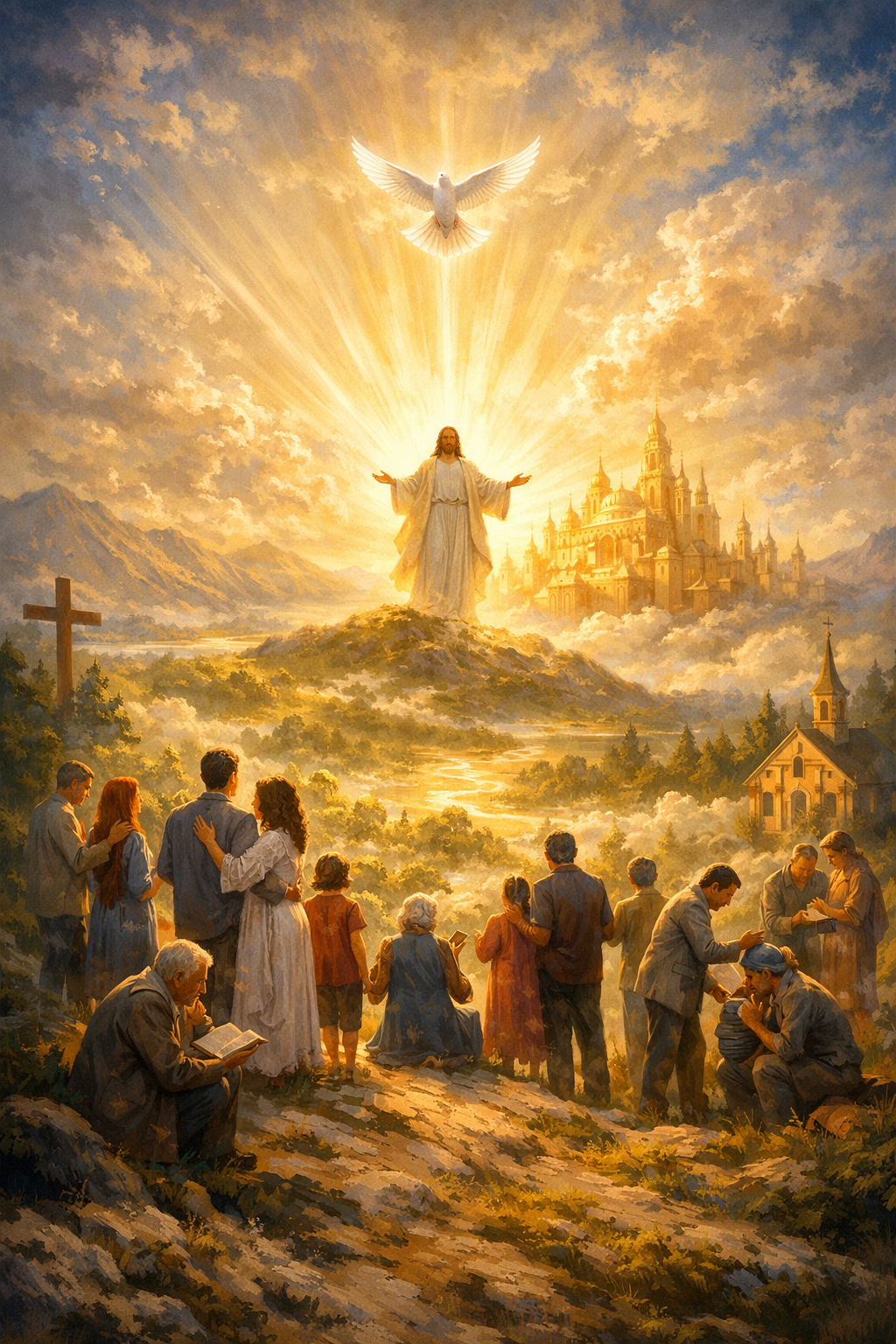
Christianity as it was Meant to Be
by Dr. Peter A. Kerr
This website asks the question “what was Christianity meant to be?” After 2000 years of theological reflection, what have we learned from the life of Jesus and from the Bible taken as a whole? If the ideas on this website were broadly adopted, Christianity would become more beautiful, more hopeful, more morally serious, and less fearful than it has become in modern times.
The deepest change would be in the felt character of God. Many Christians have been taught, implicitly or explicitly, to imagine God first as the supreme manager of outcomes. Christianity, as it was meant to be, begins elsewhere. It begins with God as the perfect Father of holy love, forming His children for real communion. Once that vision takes hold, doctrine on paper begins to change tone in prayer, preaching, counseling, evangelism, parenting, and discipleship.
Much of popular Christianity treats life as though the highest goal is to discover the hidden script and avoid making mistakes. Christianity, as it was meant to be, asks a different question: not, “How do I avoid choosing?” but, “How do I become the kind of person who chooses well in the light of Christ?” That shift makes courage, wisdom, maturity, and holiness more central than anxiety over secret decrees. The goal is no longer mere survival or conformed compliance. The goal is formation.
Prayer also changes. It ceases to feel like a religious appendix to real life and becomes one of the chief ways redeemed humanity participates in God’s governance of the world. Prayer could no longer be dismissed as pious background noise. It becomes the means to reclaim dominion and participate in shared reign within Christ.
Churches would likely pray more often, more concretely, and more expectantly. Prayer meetings would move from the margins toward the center. Intercession would recover its gravity. Anxiety would abate as in everything people would offer their petitions to God and faithfully expect His real action in our world.
The moral atmosphere would change as well. Christians would still confess sin honestly, perhaps more honestly than before, yet they would no longer treat defeat as the norm and holiness as the specialty of a few unusually gifted saints. The Church would speak more biblically of saints saved from sin, not merely of sinners saved by grace. The expectation would rise. In Christ, sin’s mastery has been broken. The Christian life would become less excuse-friendly and more transformation-ready.
Evangelism would likely become gentler and warmer, yet also more urgent. People would be seen less as objects in a hidden sorting process and more as image-bearers of immense worth, loved by God and invited into everlasting communion. Witness would become less manipulative, less harsh, and less suspicious. Christians would appeal more and coerce less. Yet urgency would not diminish, because refusal still matters. Love is not softness. Love is luminous seriousness.
The Church would also be forced to rethink power. If Christ is the criterion of all theology, then power cannot be defined over against Jesus. That would move believers away from domination, triumphalism, and fear-based authority. Leadership would remain. Discipline would remain. Truth would remain. Yet the style would change. Pastors would aim more to shepherd than to control. Institutions would ask whether they are forming love or merely enforcing compliance.
Suffering, too, would be interpreted differently. It would be seen less as mere punishment or as the product of some inscrutable scripting, and more as part of the school of love. Such a vision does not remove mystery, nor does it make pain easy. It does, however, change the frame. Life becomes less a test of passive endurance and more a place where faith, courage, holiness, and likeness to Christ are formed. The question begins to shift from, “Why is God doing this to me?” toward, “How might Christ form me through this without ceasing to be good?” Instead of pain being inflicted by God, Christians would recognize it is being shared by Him.
Beauty would return as a major category. Christianity often sounds like a system of commands, duties, and correctives. Yet holiness is not merely rule-keeping. It is radiance. It is becoming transparent to divine life. When light, love, beauty, and holiness are held together, worship grows more doxological, preaching grows more luminous, and discipleship becomes more than behavior management. It becomes the slow unveiling of glory.
The long conflict over sovereignty and freedom would also be recast. Christians would stop treating choice as a division of labor between a powerful God and meaningful human response. Christianity, as it was meant to be, sees non-coercive sovereignty not as a lesser view of God, but as a higher one. Such a vision reduces fatalism, passivity, and confusion about responsibility. It makes believers more active, not less, because their choices are understood as real arenas of sanctification and entrusted dominion.
Theology itself would become more tightly Christ-centered. Too much Christian thinking still begins with abstract attributes and only later tries to reconcile them with Jesus. Christianity, as it was meant to be, reverses the order. It asks first, “Can this doctrine be honestly said in the light of Christ?” That does not weaken theology. It purifies it. Some inherited pictures of God would soften. Confidence that Jesus truly reveals the Father would sharpen.
Such a vision could also draw Christians into greater unity around a shared moral and spiritual center, even where disagreement remains. Image, dominion, holiness, prayer, freedom, sanctification, kingdom, beauty, and communion would no longer feel like scattered topics. They would begin to cohere. Debates would not vanish, but they would become less chaotic because they would happen within a more shared understanding of what humanity is for.
Of course, dangers remain. Some would overcorrect and become suspicious of any strong divine action. Some would weaken judgment in the name of love. Some would turn luminous metaphors into vague doctrine. No theological recovery produces automatic perfection.
Still, the overall result would be unmistakable. Christianity would become more Christlike in its picture of God, more hopeful about transformation, more serious about holiness, more committed to prayer, less dominated by fear, less attracted to political and religious coercion, and more radiant in its understanding of what salvation is for.
In a sentence, Christianity would shift from a faith preoccupied with control, status, and survival toward a faith centered on formation, communion, holy love, and the restoration of radiant human dominion in Christ.
The deepest change might be this: Christians would stop asking merely how to get to Heaven and start asking how to become the kind of people who can shine there.