LUMEN and Catholicism
by Dr. Peter A. Kerr
Catholic theology has long insisted Christianity is not merely a message to be believed, but a life to be shared. Salvation, on this account, is not exhausted by forgiveness alone. It is participation—participation in God’s life through Christ, sustained by grace, mediated through the Church, and oriented toward holiness. In this emphasis, LUMEN finds deep resonance rather than opposition.
LUMEN does not approach Catholicism as an external critic, nor as a system to be corrected. It approaches Catholic theology as a fellow witness to a central biblical truth: God saves by sharing His life. Grace is not merely a verdict declared from afar; it is a gift poured out, received, and lived.
Shared Grammar: Participation Before Performance
Catholic theology has consistently affirmed grace is transformative, not merely declarative. Scripture speaks this way from beginning to end. Believers are not only forgiven, but “made alive together with Christ” (Eph 2:5). They are not merely acquitted, but “new creations” (2 Cor 5:17). They are not only counted righteous, but invited to “participate in the divine nature” (2 Pet 1:4).
LUMEN affirms this participatory grammar wholeheartedly. Holiness is not perfection achieved through effort, but participation in God’s own holy life. Grace does not replace human agency; it heals and empowers it. This is why Scripture can simultaneously insist salvation is God’s work and believers are genuinely called to grow, to mature, and to cooperate: “Work out your salvation with fear and trembling, for it is God who is at work in you” (Phil 2:12–13).
Here, LUMEN and Catholic theology speak the same language. Grace precedes, accompanies, and completes human response. There is no rivalry between divine action and human participation, because participation itself is the gift.
Sacramentality and the Logic of Incarnation
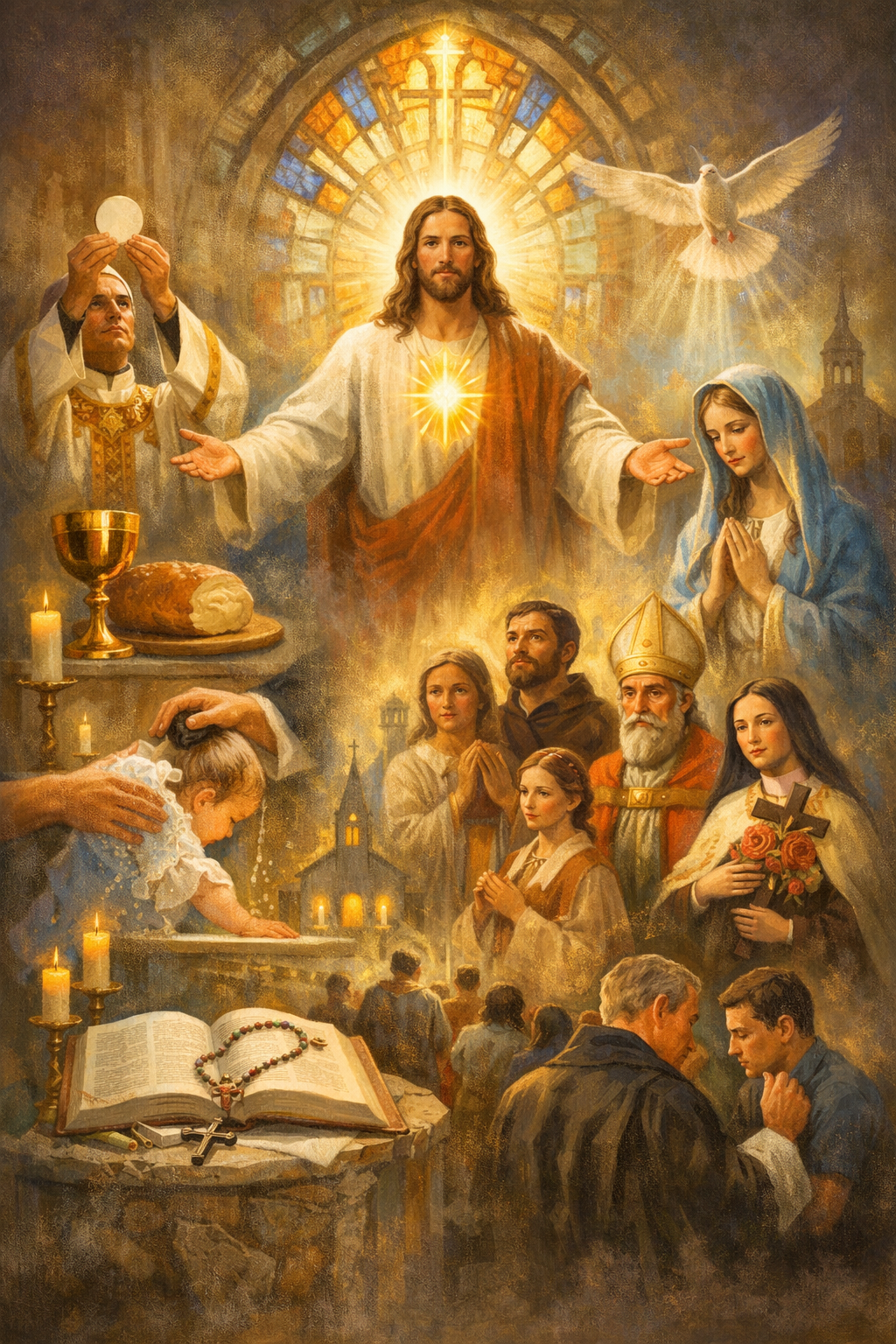
Catholic theology’s sacramental vision arises directly from the Incarnation. If God truly takes flesh, then material reality can mediate divine life without collapsing into idolatry. Scripture affirms this logic repeatedly. God uses water to cleanse (John 3:5), bread and wine to communicate communion (1 Cor 10:16), oil and touch to heal (James 5:14), and embodied community to form saints (1 Cor 12:12–27).
LUMEN shares this incarnational instinct. God does not save by bypassing creation, but by filling it with holy-love. Redemption is not an escape from material life, but its healing and reorientation. Breadth-love moves outward in creation; depth-love moves downward into brokenness. Sacraments, in this light, are not magical interventions, but patterned participations—spaces where God’s self-giving life is reliably offered and received.
Where LUMEN adds emphasis is in guarding the relational core of sacramentality. Sacraments are not mechanisms that work apart from trust, nor obligations imposed to secure standing. They are invitations into shared life. Their power flows not from ritual precision, but from God’s faithful self-giving and the open reception of that gift (John 6:63).
Holiness, Merit, and Gift
One of the most persistent misunderstandings between Protestant and Catholic theology concerns merit. LUMEN reframes this discussion by returning to the biblical center. Scripture speaks of reward, inheritance, and growth without implying God is indebted to human achievement (Matt 25:21; Rom 8:17). Any “merit” language in Scripture is always derivative—God crowning His own work in His children.
LUMEN aligns with the Catholic insistence that growth in holiness is real, meaningful, and consequential. Yet it also insists, with Scripture, that this growth is always grace-enabled: “What do you have that you did not receive?” (1 Cor 4:7). Human cooperation never competes with grace; it manifests grace. Holiness is not earned proximity to God. It is lived participation in the God who is already near.
This protects against both pride and despair. The saint cannot boast, because all is gift. The struggler need not despair, because growth is possible. God’s call to holiness—“Be holy, for I am holy” (1 Pet 1:16)—is not cruel irony. It is an invitation grounded in divine generosity.
The Church as Participatory Space
Catholic theology rightly emphasizes the Church is not merely an institution, but is the Body of Christ. Scripture consistently frames salvation as incorporation into a people, not isolation as individuals (Eph 2:19–22). Faith is personal, but never private. Formation happens within shared practices, shared worship, and shared love.
LUMEN affirms this ecclesial vision. Participation in God’s life is never abstract. It is learned through confession, forgiveness, Eucharistic thanksgiving, mutual service, and patient endurance with others. The Church becomes the primary school of holy-love, not because it is flawless, but because God is faithful within it.
Where LUMEN offers gentle clarification is in resisting any tendency to collapse participation into control. Authority in the Church exists for formation, not coercion (Mark 10:42–45). Unity arises from shared life, not enforced uniformity. Truth is guarded best when it is embodied in love (Eph 4:15).
Mary, the Saints, and Exemplary Participation
Catholic devotion to Mary and the saints reflects a profound theological intuition: participation in God’s life is not theoretical. It can be seen. Scripture itself honors those who respond fully to God’s invitation: “Blessed are those who hear the word of God and keep it” (Luke 11:28). Mary’s fiat—“Let it be to me according to your word” (Luke 1:38)—becomes a paradigmatic image of faith as receptive participation rather than control.
LUMEN affirms this exemplary dimension. The saints are not competitors with Christ, but witnesses to what Christ’s life can produce in human beings. They do not replace grace; they display it. They remind the Church that holiness is possible, embodied, and varied in expression.
Catholicity Without Anxiety
LUMEN approaches Catholic theology with gratitude rather than suspicion. Where Catholicism has preserved the language of participation, sacramentality, and formation, it has safeguarded essential biblical truths. Where clarification is needed, LUMEN offers it not by reduction, but by re-centering everything in God’s holy-love revealed in Christ.
Catholic theology and LUMEN meet most deeply here: God does not save to remain distant. He saves to dwell with His people (Rev 21:3). Salvation is not merely rescue from guilt, but entrance into shared life. Holiness is not perfection anxiously pursued, but communion patiently lived.
In this shared vision, grace is not thin, Christ is not divided, and the Christian life is not a holding pattern. It is participation—beginning now, deepening over time, and fulfilled in the life of the world to come.
Supporting Scripture (in NASB)
Ephesians 2:5 even when we were dead in our transgressions, made us alive together with Christ (by grace you have been saved).
2 Corinthians 5:17 Therefore if anyone is in Christ, he is a new creature; the old things passed away; behold, new things have come.
2 Peter 1:4 For by these He has granted to us His precious and magnificent promises, so that by them you may become partakers of the divine nature, having escaped the corruption that is in the world by lust.
Philippians 2:12–13 So then, my beloved, just as you have always obeyed, not as in my presence only, but now much more in my absence, work out your salvation with fear and trembling; for it is God who is at work in you, both to will and to work for His good pleasure.
John 3:5 Jesus answered, “Truly, truly, I say to you, unless one is born of water and the Spirit he cannot enter into the kingdom of God.”
1 Corinthians 10:16 Is not the cup of blessing which we bless a sharing in the blood of Christ? Is not the bread which we break a sharing in the body of Christ?
James 5:14 Is anyone among you sick? Then he must call for the elders of the church and they are to pray over him, anointing him with oil in the name of the Lord.
1 Corinthians 12:12–27 For even as the body is one and yet has many members, and all the members of the body, though they are many, are one body, so also is Christ. For by one Spirit we were all baptized into one body, whether Jews or Greeks, whether slaves or free, and we were all made to drink of one Spirit. For the body is not one member, but many. If the foot says, “Because I am not a hand, I am not a part of the body,” it is not for this reason any the less a part of the body. And if the ear says, “Because I am not an eye, I am not a part of the body,” it is not for this reason any the less a part of the body. If the whole body were an eye, where would the hearing be? If the whole were hearing, where would the sense of smell be? But now God has placed the members, each one of them, in the body, just as He desired. If they were all one member, where would the body be? But now there are many members, but one body. And the eye cannot say to the hand, “I have no need of you”; or again the head to the feet, “I have no need of you.” On the contrary, it is much truer that the members of the body which seem to be weaker are necessary; and the parts of the body which we think less honorable, on these we bestow more abundant honor, and our less presentable members become much more presentable, whereas our more presentable members have no need of it. But God has so composed the body, giving more abundant honor to that member which lacked, so that there may be no division in the body, but that the members may have the same care for one another. And if one member suffers, all the members suffer with it; if one member is honored, all the members rejoice with it. Now you are Christ’s body, and individually members of it.
John 6:63 It is the Spirit who gives life; the flesh profits nothing; the words that I have spoken to you are spirit and are life.
Matthew 25:21 His master said to him, ‘Well done, good and faithful slave. You were faithful with a few things, I will put you in charge of many things; enter into the joy of your master.’
Romans 8:17 and if children, heirs also, heirs of God and fellow heirs with Christ, if indeed we suffer with Him so that we may also be glorified with Him.
1 Corinthians 4:7 For who regards you as superior? What do you have that you did not receive? And if you did receive it, why do you boast as if you had not received it?
1 Peter 1:16 because it is written, “You shall be holy, for I am holy.”
Ephesians 2:19–22 So then you are no longer strangers and aliens, but you are fellow citizens with the saints, and are of God’s household, having been built on the foundation of the apostles and prophets, Christ Jesus Himself being the corner stone, in whom the whole building, being fitted together, is growing into a holy temple in the Lord, in whom you also are being built together into a dwelling of God in the Spirit.
Mark 10:42–45 Calling them to Himself, Jesus said to them, “You know that those who are recognized as rulers of the Gentiles lord it over them; and their great men exercise authority over them. But it is not this way among you, but whoever wishes to become great among you shall be your servant; and whoever wishes to be first among you shall be slave of all. For even the Son of Man did not come to be served, but to serve, and to give His life a ransom for many.”
Ephesians 4:15 but speaking the truth in love, we are to grow up in all aspects into Him who is the head, even Christ.
Luke 11:28 But He said, “On the contrary, blessed are those who hear the word of God and observe it.”
Luke 1:38 And Mary said, “Behold, the bondslave of the Lord; may it be done to me according to your word.” And the angel departed from her.
Revelation 21:3 And I heard a loud voice from the throne, saying, “Behold, the tabernacle of God is among men, and He will dwell among them, and they shall be His people, and God Himself will be among them.”